

Key Takeaways
- There are three ways to get a local business website: Hire an agency, build it yourself with a DIY website builder, or use a platform that builds and maintains the site for you.
- Pantora is our pick for most local businesses: It builds a complete site from your real business during signup, keeps it current every week, and handles the calls, leads, and reviews the site brings in.
- Agencies cost the most: Hook Agency's websites run $12,000 to $24,000, and Scorpion is estimated at $16,000 to $60,000 a year. Both bundle the site with ongoing marketing.
- DIY website builders cost the least, but you do all the work: Wix starts free, Squarespace at $19 a month, and GoDaddy at $9.99 a month. By default, the site just sits there. It doesn't grow or drive revenue.
- The real cost is the jobs you miss: While a DIY site sits still, competitors using platforms like Pantora or spending heavily on online marketing keep winning the customers searching for you.
Most local business owners don't want a website project. They want a site that looks professional, explains what they do and where they work, and makes the phone ring. Then they want to get back to the job.
The trouble is that every option asks for something. Agencies ask for money, often a lot of it. DIY website builders ask for your evenings. And a site that nobody updates slowly stops doing its job, no matter how it was built.
This guide compares six website platforms for local businesses in 2026: our own platform, two agencies, and the three DIY website builders most owners consider. For each one, we cover what you get, what it costs, the pros and cons, and who it fits best. All prices were checked on each company's website on October 2, 2026.
What makes a good website platform for a local business?
A good platform gets you a site that wins jobs without turning you into a web designer. For a dentist, a med spa, or a landscaper, that comes down to four things.
- Someone has to build it. Either you do it, an agency does it, or software does it for you.
- It has to say the right things. That means your services, the towns you serve, your hours, your reviews, and a clear way to call or book.
- It has to bring in leads. Calls and form submissions should land somewhere you'll see them, not in an inbox you check once a week.
- It has to stay current. New services, new reviews, new towns, and new questions from customers all need to show up on the site over time.
Every option below handles these differently. Keep them in mind as you read.
The best website platforms for local businesses at a glance
| Platform | Type | Best for | Who does the work | Starting price |
|---|---|---|---|---|
| Pantora | Done-for-you platform | Local service businesses that want the site built and kept up for them | Pantora builds and improves it, you approve | One flat monthly price, 14-day free trial |
| Scorpion | Agency | Multi-location and franchise businesses with large marketing budgets | Scorpion's team | Estimated $16,000 to $60,000 per year |
| Hook Agency | Agency | Contractors doing $3M to $15M a year | Hook's team | $12,000 website, split over 12 months |
| Wix | DIY website builder | Hands-on owners who want lots of built-in tools | You do all the work | Free, paid plans from $17/mo |
| Squarespace | DIY website builder | Design-focused businesses that will do the work | You do all the work | $19/mo, 14-day free trial |
| GoDaddy | DIY website builder | Getting a basic site live fast for the least money | You do all the work | Free, paid plans from $9.99/mo |
1. Pantora: best for local businesses that want to increase revenue
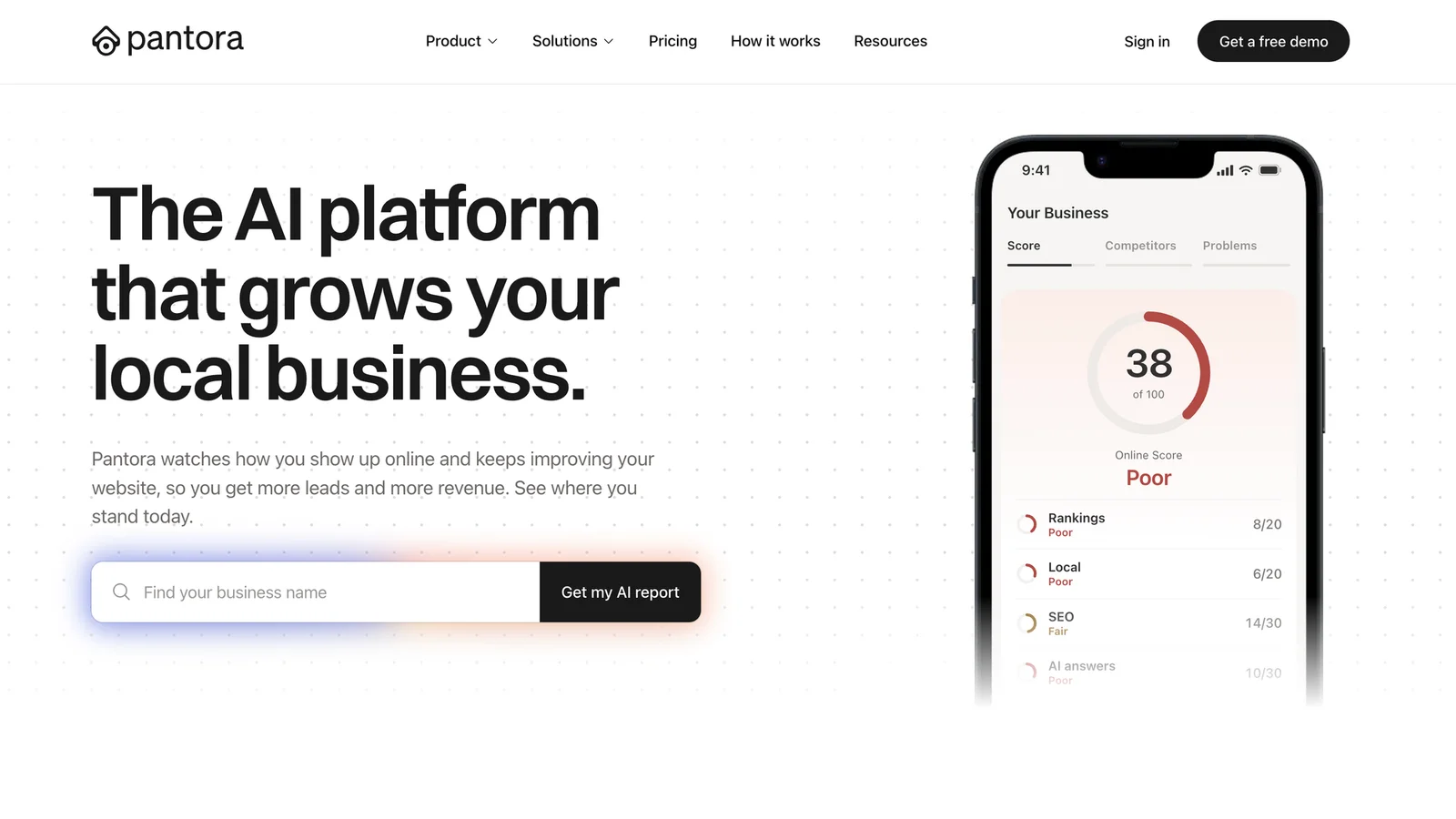
We built Pantora to give local businesses the tools used by the big guys, without having to spend 100's of thousands on marketing teams and web designers. When you sign up, Pantora studies your business, including your old site, your Google Business Profile, your services, the towns you serve, your reviews, and your brand colors. Then it builds a complete, multi-page AI local business website from all of it.
The site lands as a draft. You look it over, change anything you want, and publish when you're happy. From then on, Pantora keeps working on it. Every week it checks how you show up on Google and in AI answers, drafts improvements to your site, and sends them to one inbox for your approval.
The website is also connected to the rest of your business. Calls, texts, and form submissions become leads in one pipeline, follow-up texts go out on their own, and your Google reviews flow onto the site as they come in.
Key features
- A complete website built from your real business during signup, with a page for every service and every town you cover.
- More than 200 professionally designed sections and 60+ site-wide looks, so the site never looks like a template you picked in a hurry.
- Editing by asking. Type "add a page for teeth whitening in Montclair" and the page appears.
- Weekly improvements drafted for you, and nothing goes live until you approve it. That's our AI local business website automation at work.
- Testimonial sections that pull in your latest Google reviews automatically.
- A built-in chat on your site that answers visitor questions and captures leads.
- Every form submission becomes a tracked lead instead of an email that gets lost.
- Hosting included, with your own domain or a free Pantora address.
- Tracking of how often ChatGPT and Google's AI mention your business next to your local competitors.
Pricing
Pantora is one flat monthly price with everything included: the website, hosting, weekly improvements, AI phone answering, the lead pipeline, follow-up texts, and review management. There are no setup fees, no per-lead fees, and no add-ons. You can start with a 14-day free trial and cancel anytime.
Pros
- The site exists by the end of signup. There's no months-long build and no blank template to fill in.
- It keeps getting better without you doing the work. You approve changes in a few minutes a week.
- The website, phone, leads, and reviews live in one place, so nothing falls through the cracks between tools.
- No long-term contract, so you can leave if it isn't working for you.
- It shows you how AI answers talk about your business, which no website builder on this list does.
Cons
- There's no free plan, only the 14-day trial.
- Pantora doesn't run paid ad campaigns. If Google Ads or Meta ads are your main need, you'll want an ad partner too.
- It's built for service businesses and practices. If you mainly sell products online, a store builder like Wix or Squarespace is a better fit.
Who is Pantora best for?
Pantora is best for local service businesses and practices, like contractors, home service companies, dental offices, med spas, and auto shops. It fits owners who want a website that looks like they paid an agency, stays current on its own, and turns visitors into booked jobs, without hiring anyone to run it.
See How Your Website Stacks Up
The free scan takes about two minutes and shows how your business comes up on Google and in AI answers next to your local competitors.
2. Scorpion: best for multi-location and franchise businesses with large marketing budgets
Scorpion is a large digital marketing agency for local service businesses. It works with home services, legal, medical, and franchise companies, and says it has helped more than 20,000 businesses. A website is one part of a bigger package that can include search, ads, and lead tools.
Scorpion builds the site to match your brand and keeps it updated for you. Its pitch is that "a website is only the beginning," so most clients buy the site together with other marketing services.
Key features
- Custom websites built for local service businesses, designed for speed and mobile.
- Lead scoring and connections to the customer software common in each industry.
- Search, digital ads, and Google Local Services Ads management.
- AI chat and online scheduling on the site.
- Video and photography from an in-house studio team.
Pricing
Scorpion doesn't publish prices, so this is an estimate: expect roughly $16,000 to $60,000 a year, depending on how many services you buy. The exact number comes from a proposal after you book a meeting.[1]
Pros
- One company can run your website, search, and ads together.
- Deep experience with franchise and multi-location businesses.
- Site updates and upkeep are handled by their team.
Cons
- No public pricing, so you can't confirm the cost without a sales meeting.
- The website is usually sold as part of a larger marketing package.
- Changes go through an account team instead of happening when you ask.
Who is Scorpion best for?
Scorpion is best for larger businesses, franchises, and multi-location groups that want one agency to run their website, search, and paid ads, and have the budget for it.
3. Hook Agency: best for established contractors who want an agency
Hook Agency is a marketing agency for home service companies, especially roofing, HVAC, and plumbing. It builds websites and runs search, paid ads, and social ads for contractors.
Hook is open about its pricing, which is rare for an agency. It also says it focuses on businesses with $3 million to $15 million in revenue and asks clients for a yearly commitment.
Key features
- A standard website with your colors, content, and photos, or a fully custom site.
- Local search and Google Business Profile work.
- Google Ads, Local Services Ads, and Meta ads management.
- Help showing up in AI search results, sold as its own service.
- Monthly reporting with an account team.
Pricing
A standard website costs $12,000 and a custom website costs $24,000, each split into 12 monthly payments ($1,000 or $2,000 a month). Local search starts at $2,800 a month, paid search at $2,000 a month, and Meta ads at $3,000 a month.[2]
Pros
- Clear, published prices.
- Website, search, and ads from one partner.
Cons
- Expensive. A standard site plus local search starts at $3,800 a month for the first year.
- A yearly commitment is required.
- Smaller and newer businesses usually fall outside the $3 million to $15 million revenue range Hook works with.
Who is Hook Agency best for?
Hook Agency is best for established roofing, HVAC, and plumbing companies in its revenue range that want an agency team and can commit to a year.
4. Wix: best DIY website builder for hands-on owners
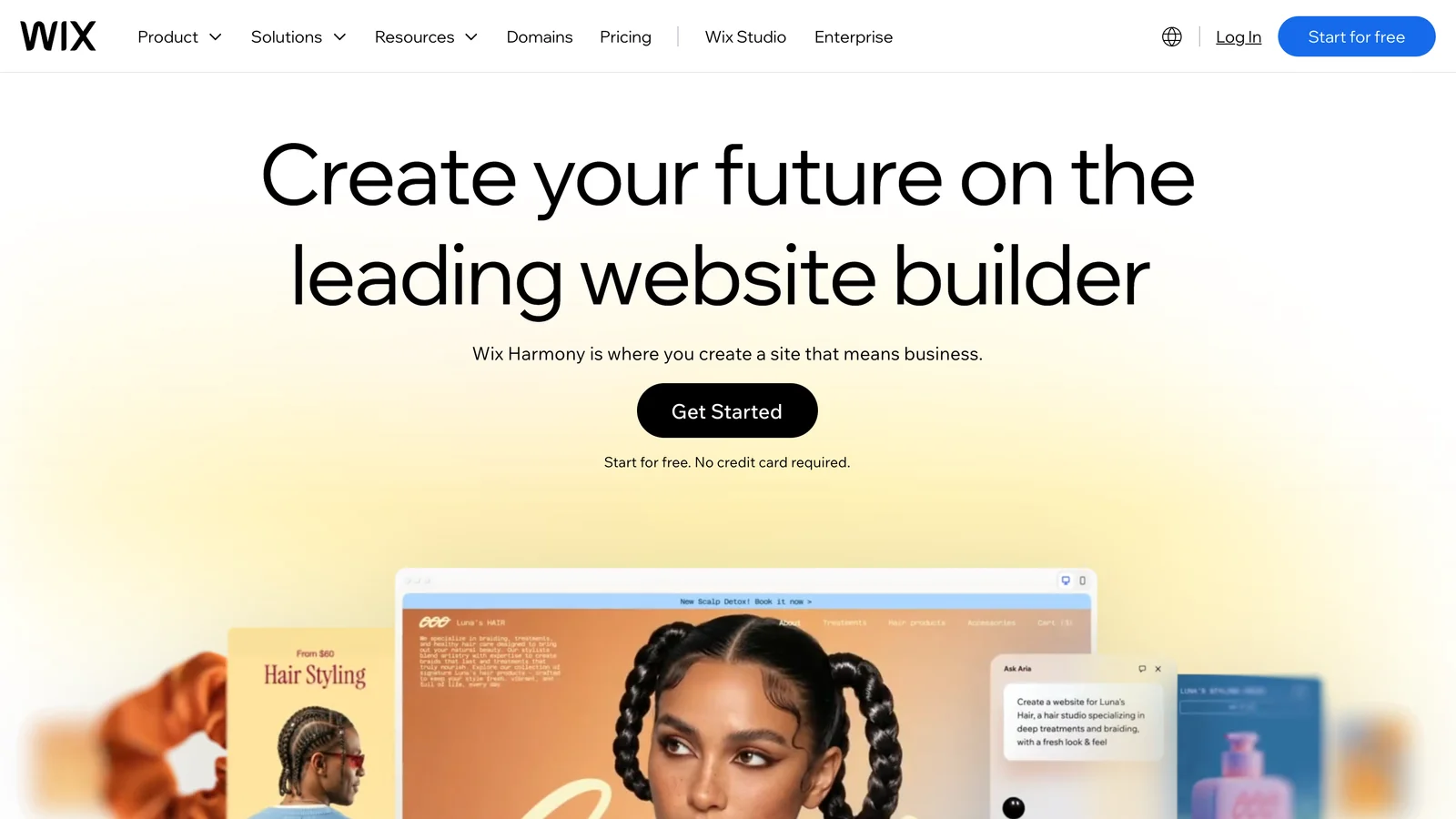
Wix is one of the most popular DIY website builders. Its AI builder, Wix Harmony, creates a starting site from a prompt, and then you refine it with a drag-and-drop editor. Wix also includes tools for booking, online stores, and managing leads.
But DIY means you do all the work yourself. You write the pages, design them, and update them when something changes. By default, your Wix site just sits there. It doesn't add pages, chase leads, or grow your revenue unless you do it.
Key features
- Wix Harmony, which generates a site from a description and lets you switch to drag-and-drop editing.
- More than 2,000 templates.
- Built-in scheduling, online store, and lead tools.
- Hosting and a free domain for one year on paid plans.
Pricing
Wix has a free plan. Paid plans are Light at $17 a month, Core at $29, Business at $39, and Business Elite at $159, all billed yearly. There's a 14-day money-back guarantee.[3]
Pros
- You can start for free.
- Lots of features and apps for e-commerce websites.
- Full control over the design.
Cons
- It's DIY. You write, design, and update every page yourself.
- The site doesn't improve or bring in leads on its own.
- You need a paid plan to use your own domain and remove Wix branding.
- The many options can turn a simple site into a long project.
Who is Wix best for?
Wix is best for owners who enjoy building things themselves, have time to keep the site updated, and want booking or an online store built in.
5. Squarespace: best DIY website builder for design-focused businesses
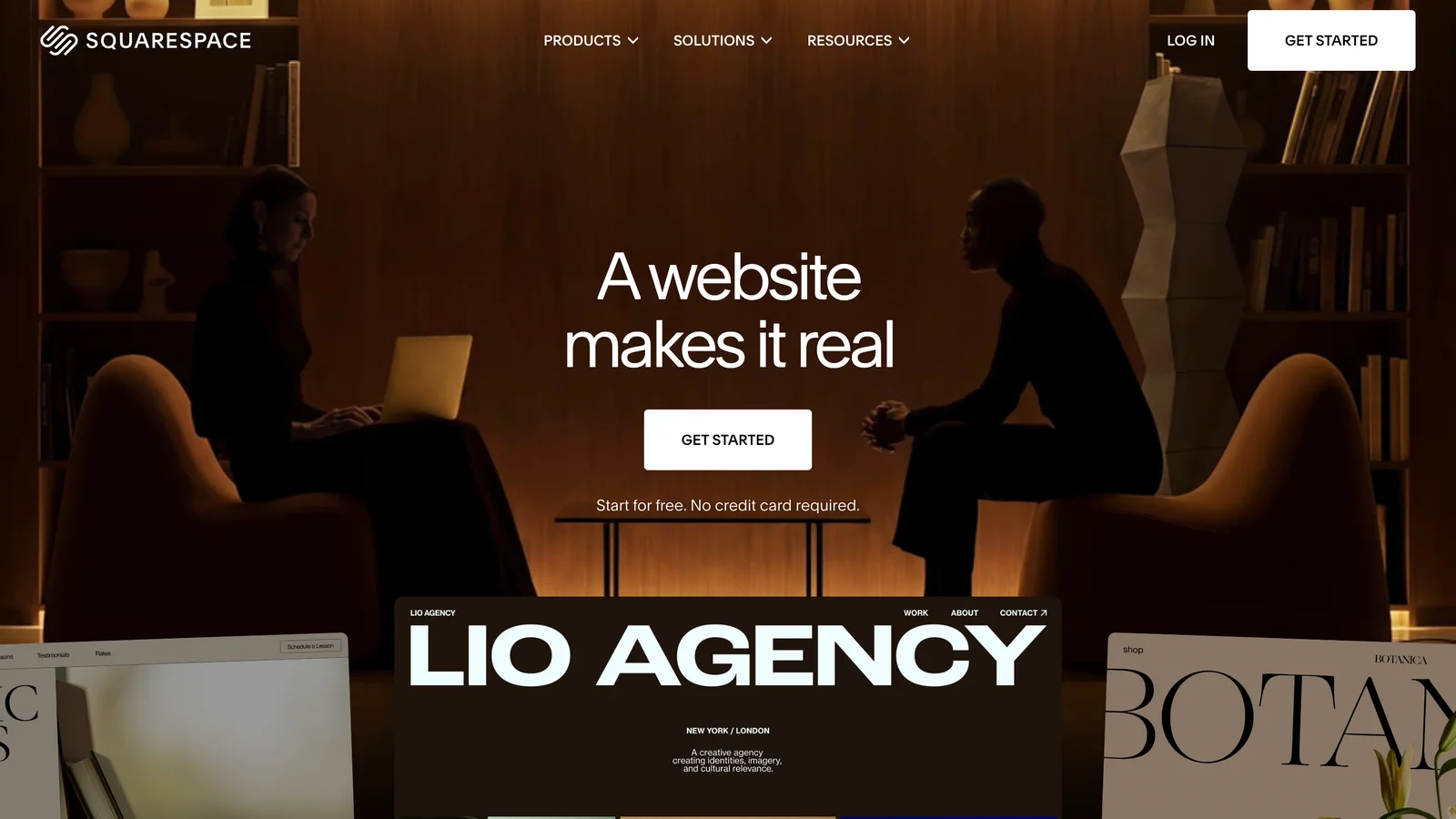
Squarespace is known for polished templates and a clean editor. It works well for businesses where looks matter a lot, like salons, photographers, and designers. It also includes scheduling, invoicing, and built-in AI tools for writing and design.
Like Wix, Squarespace is DIY. You do all the work yourself, from picking a template to writing every service page. Once it's live, the site stays exactly as you left it. It won't grow or drive revenue on its own.
Key features
- Design-forward templates that look good with little effort.
- Built-in AI tools.
- Scheduling, invoicing, and selling services.
- Hosting and a free custom domain for the first year on annual plans.
Pricing
Squarespace plans are Basic at $19 a month, Core at $29, Plus at $49, and Advanced at $99 when you pay annually. It offers a 14-day free trial.[4]
Pros
- Some of the best-looking templates of any builder.
- A simpler editor than Wix.
- Scheduling and invoicing are included.
Cons
- It's DIY. You write and update every page yourself.
- The site doesn't improve or bring in leads on its own.
- The Basic plan adds a 2% transaction fee on online store sales.
- Nothing is built from your business information. You start from a template and fill it in.
Who is Squarespace best for?
Squarespace is best for design-focused businesses whose owners have the time and interest to build and maintain their own site.
6. GoDaddy: best DIY website builder for getting online cheaply
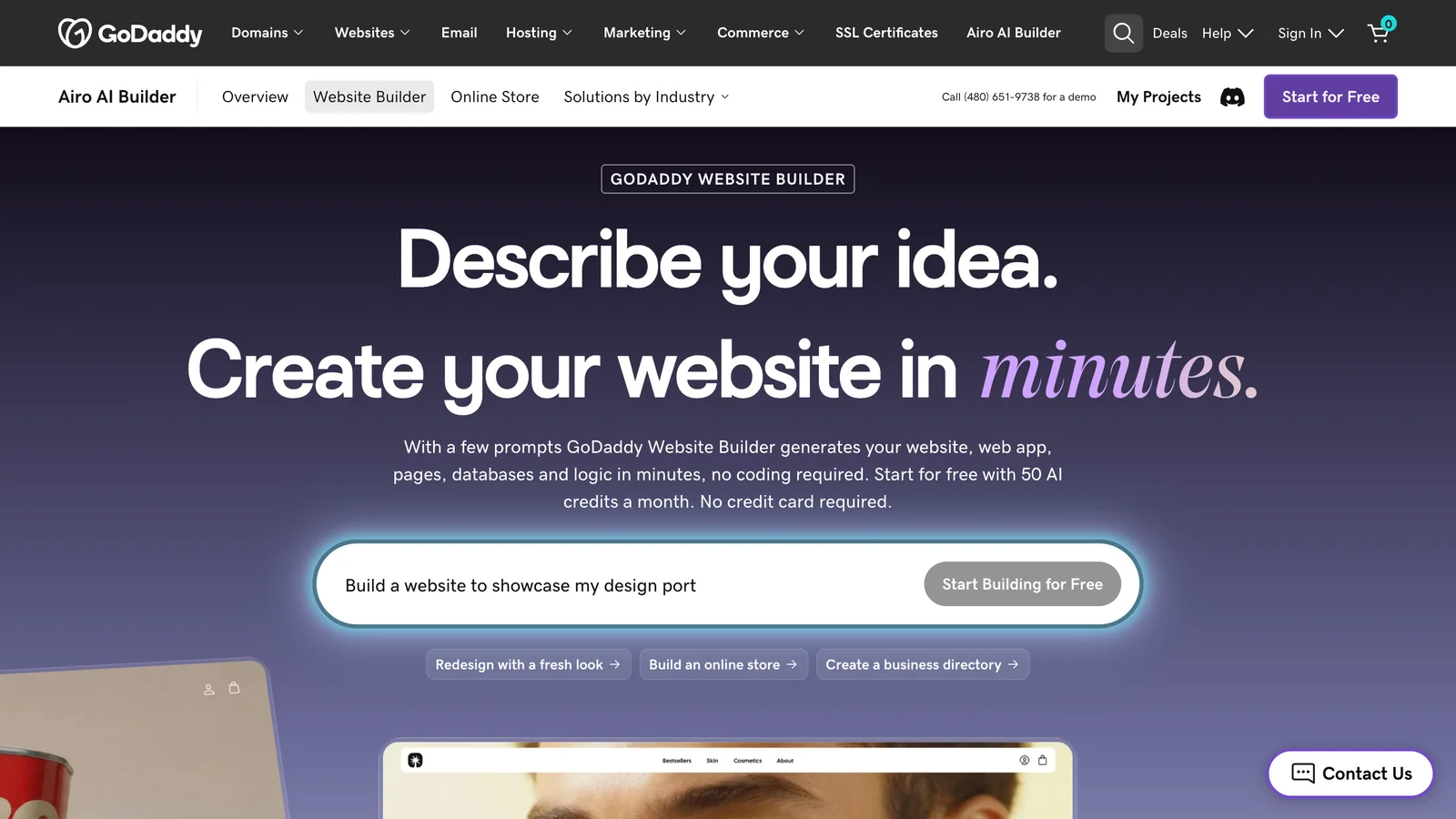
GoDaddy is best known for domains, and many owners already have an account there. Its website builder uses Airo, GoDaddy's AI tool, to create a site from a description of your business. GoDaddy also offers a design service where its team builds a site for you.
The builder itself is DIY, so you do all the work yourself. Even with the design service, GoDaddy builds the site once and hands it to you. After that, it just sits there unless you update it, and it won't grow or drive revenue by itself.
Key features
- An AI builder that creates your site from a few prompts.
- Domains, email, and your website in one account.
- An optional design service where a GoDaddy designer builds your site.
Pricing
You can start for free with 50 AI credits a month and no credit card. Paid plans start at $9.99 a month with an annual term. The design service costs $499.99 one time, plus an annual hosting fee.[5][6]
Pros
- The lowest starting price on this list.
- Fast to get a simple site online.
- Convenient if your domain is already at GoDaddy.
Cons
- Sites tend to be basic, with fewer design options than Wix or Squarespace.
- The free plan's AI credits run out quickly if you make lots of changes.
- It's DIY after launch. Updates are up to you, even if a GoDaddy designer built the site.
- The site doesn't improve or bring in leads on its own.
Who is GoDaddy best for?
GoDaddy is best for brand-new businesses that need a simple site live today for as little money as possible.
Agency, DIY website builder, or done-for-you platform?
Each type of platform makes a different trade between money and time.
An agency costs the most, and it can still take up a lot of your time with strategy calls, check-ins, and monthly review meetings. Someone else builds the site and runs your marketing. But you pay thousands up front or every month, changes go through an account team, and most agencies ask for a contract.
A DIY website builder costs the least money and the most time. The monthly plan is cheap. But you do all the work yourself: you're the designer, the writer, and the person who remembers to update the site when you add a service or a town. For most busy owners, that last part never happens.
So by default, a DIY site just sits there. It doesn't grow, and it doesn't drive revenue. Meanwhile, competitors using platforms like Pantora, or spending heavily on online marketing, keep adding pages, collecting reviews, and showing up in more searches. That gap is the biggest cost of a DIY site: the customers who find them instead of you.
A done-for-you platform sits in between. Software builds the site and keeps it current, and you approve the changes. That's the model we chose for Pantora, because it gives an owner an agency-quality site without the agency bill or the weekend project.
What should a local business website include?
Whichever platform you choose, check that your site has these:
- A clear headline that says what you do and where, like "Family dentistry in Montclair and Glen Ridge, NJ."
- A separate page for each main service you offer.
- A page for each town or area you serve, if you cover more than one.
- Your phone number at the top of every page, plus a short form to request a quote or book.
- Real reviews from your customers, ideally kept current.
- Your hours, service area, and how pricing works, written out in plain sentences.
- A short about section that says who you are and whether you're locally owned.
- Fast load times on a phone, since most local searches happen on one.
What does a local business website really cost?
The monthly price is only part of the cost. Here's what a year looks like for a dental practice that wants a professional site that stays current.
With an agency at Hook's published prices, a standard website is $12,000 over the first year. Add local search at $2,800 a month and the year comes to about $45,600.
With a DIY builder like Wix on the Core plan, the plan costs $348 for the year. But you're doing all the work. If the site takes three hours a month and your time is worth $100 an hour, that's another $3,600 of your time. And if you fall behind, which most owners do, the site sits still while competitors keep growing.
With Pantora, it's one flat monthly price with no setup fee and no contract. That price covers the website, hosting, and weekly improvements, plus the phone answering, lead pipeline, follow-ups, and review management you'd otherwise buy separately.
Which website platform is right for you?
Match the choice to your budget, your time, and how much you want handled.
- You want a professional site built and kept up for you, plus help with calls, leads, and reviews: choose Pantora.
- You run many locations or a franchise and want one agency to handle your site and ads: look at Scorpion.
- You're an established contractor doing $3 million or more a year and want an agency team: look at Hook Agency.
- You enjoy building things yourself and want booking or an online store: Wix is the strongest DIY option.
- Design matters most and you have time to maintain the site: choose Squarespace.
- You're just starting out and need a simple site today for the least money: choose GoDaddy.
For most local service businesses, the website isn't the hard part. Keeping it current, answering every call it brings in, and following up on every lead is. That's why we built Pantora as local business marketing software instead of just a website builder. You can try it free for 14 days.