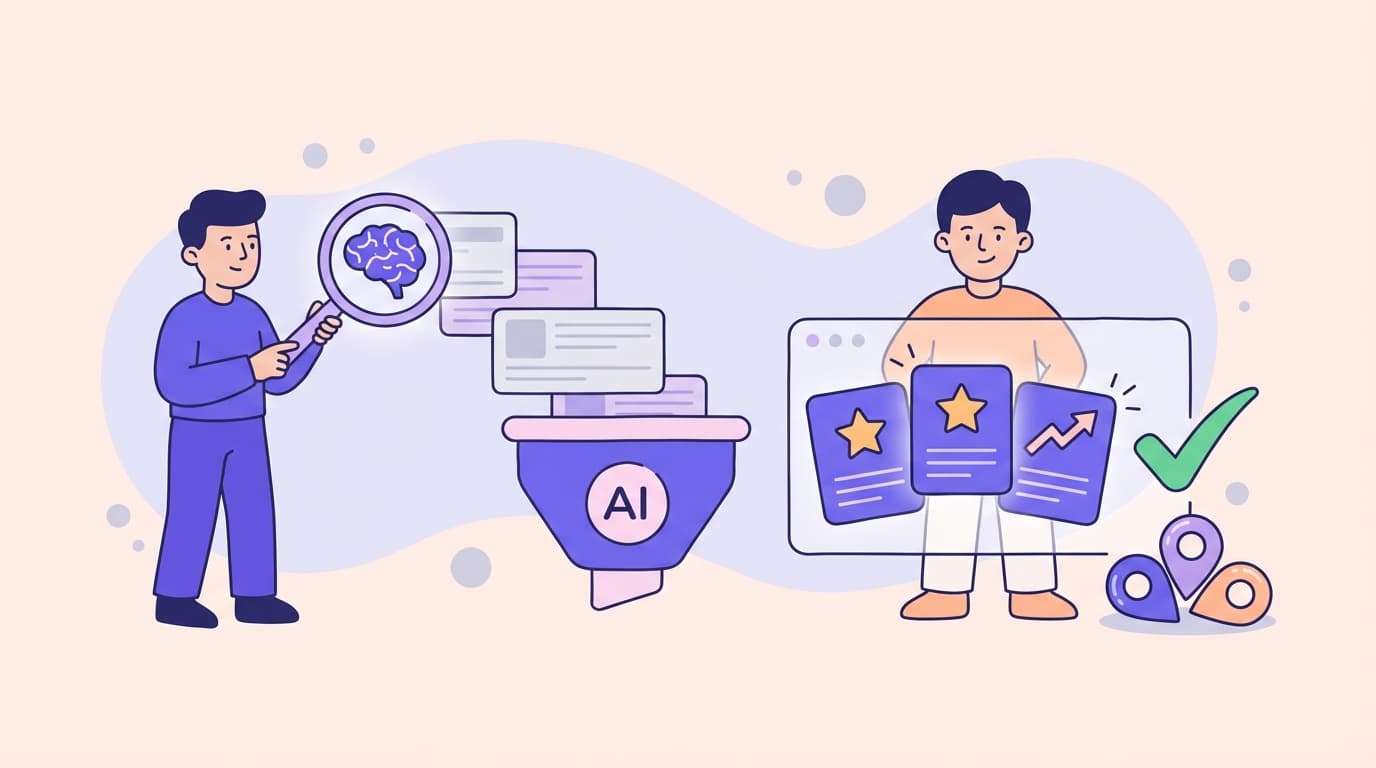
Most leads are just names and numbers. Some are tire-kickers. Some want a price over the phone. Some are calling three companies to see who answers first.
AI leads are considered quality leads because the customer usually shows up with more clarity. They have a specific problem, a location, a timeline, and a reason they’re reaching out to you.
That’s the difference between “someone found your ad” and “someone asked an assistant who they should hire.”
If you want to see whether your business shows up when people ask AI for help in your service area, you can check your AI visibility. Pantora tracks how you appear across major AI assistants, and it helps you build an online presence those assistants can actually understand.
What makes an AI lead “quality”
A quality lead is not magic. It is a lead with fewer unknowns.
When a homeowner uses ChatGPT, Google’s AI results, Gemini, or Perplexity to find a pro, they usually provide context like:
- The exact job they need done
- Their neighborhood or zip code
- What “good” looks like to them (speed, price range, warranty, experience)
- Constraints (pets, access, hours, urgency)
AI uses that context to recommend a small set of businesses that fit. So when the phone rings, you often get a caller who is already pre-sold on the type of provider they want.
That does not mean every AI lead is perfect. You can still get price shoppers and bad fits. But compared to a generic directory lead, the average AI-driven inquiry tends to come with higher intent and better information, which makes it easier to book, quote, and close.
Is AI Recommending Your Business?
See how you stack up against your competitors and let Pantora get you to the top.
AI leads usually come with stronger intent
A big reason AI leads are considered quality leads is simple: the customer is actively trying to decide, not casually browsing.
With a lot of traditional lead sources, people are still in research mode. They might be saving numbers, comparing websites, or asking friends. AI use often happens closer to a decision point because it is faster to ask:
- “Who installs EV chargers near me that pulls permits?”
- “Best pool service for weekly maintenance in my area”
- “Should I repair or replace my water heater, and who can quote it?”
Those are not casual questions. They are purchase-adjacent questions.
From your side, higher intent usually looks like:
- More calls turning into scheduled estimates
- Fewer “just checking prices” conversations
- Less time spent educating from scratch
AI filters out a lot of bad fits upfront
AI recommendations are not random. They tend to filter based on what the customer asks for, and what AI can verify about you online.
So if someone asks for “a licensed appliance repair tech who works on Samsung,” AI will try to recommend businesses that look like they actually do that.
This is one of the most overlooked parts of lead quality: fewer mismatched expectations.
In home services, bad-fit leads waste time in a few predictable ways:
- They need a service you do not offer
- They’re outside your service area
- They want a timeline you cannot meet
- They expect a price that is unrealistic for the job
AI does not eliminate those problems, but it can reduce them when your online information is clear and consistent.
This is also why “AI visibility” is not only about showing up more. It is about showing up for the right jobs.
AI recommendations borrow trust from the source
People trust recommendations. Even when they know an AI is not a human, it still feels like guidance, especially when the answer includes explanations like “known for fast scheduling” or “customers mention clean work.”
That trust often comes from the inputs AI pulls from, such as:
- Reviews and ratings
- Your Google Business Profile details (services, hours, service area)
- Your website content and FAQs
- Business listings and citations across the web
Google has been clear for years that review content and business info matter for local results, and those same signals also shape what AI can confidently summarize. Google’s guidance on improving local rankings highlights relevance, distance, and prominence, and “prominence” is heavily influenced by reputation signals like reviews and mentions across the web: https://support.google.com/business/answer/7091
So when AI points to your business, the homeowner often assumes you have already passed a credibility check.
AI leads are “informed leads,” not just contact form fills
A lead is easier to close when the customer already understands:
- What the job involves
- What questions to ask
- What red flags to avoid
- What a fair price range might be
AI is good at that education step. Sometimes that helps you. Sometimes it creates new objections. But either way, the lead is usually more informed than someone who clicked the first listing they saw.
For example, a homeowner might ask:
- “Do I need a permit for an EV charger install?”
- “What size generator do I need for a 2,000 sq ft house?”
- “How often should I service my pool filter?”
Then they ask for a recommended provider. When they contact you, they tend to ask better questions and share better details, which speeds up your quote process.
If you want background on how AI is showing up inside search results specifically, this pairs well with our breakdown of what AI Overviews are in Google.
Why some “AI leads” are not actually quality
You have probably heard someone say, “Those AI leads were junk.” That can be true, and it usually happens for a few reasons.
The lead source was really a paid lead marketplace
Some companies label anything “AI” because they use automation somewhere in the funnel. But if you are paying for shared leads or bidding against other contractors, you can still get the same old problems:
- Duplicates
- Bad info
- Customers blasting the same request to five businesses
That is not an AI lead quality issue. That is a lead marketplace model issue.
Your online info is confusing, so AI guesses
AI will fill in gaps. If your service area is vague, your services are unclear, or reviews contradict what you claim, AI may describe you incorrectly.
That creates mismatched expectations, which makes the lead feel lower quality.
Pantora helps here by building an AI-optimized site structure (with schema markup and FAQ schema) and tracking how AI describes your business, so you can catch problems early.
Your positioning attracts the wrong jobs
If your website and listings only talk about “affordable” and “same-day,” you might attract customers who only care about price and speed.
If you want higher-margin work, you need content that supports it: warranties, process, credentials, brands you service, and the types of projects you prefer.
This is the same reason reviews matter beyond star ratings. Specific reviews help set expectations. If you want to strengthen that side of your marketing, you can pair this with how to get more Google reviews for your home service business.
How to attract more quality AI leads
You do not need to become a tech expert. You need to make it easy for AI to confidently answer three things: what you do, where you do it, and why you are a safe choice.
Here are practical steps you can take.
1. Tighten up your service and location details
Start with the basics:
- List your core services in plain language (not just “solutions”)
- Spell out brands, job types, and exclusions (if you do not do warranty work, say it)
- Make service areas specific (cities, neighborhoods, counties)
Your Google Business Profile and your website should match. Inconsistency creates uncertainty, and uncertainty leads to fewer recommendations.
2. Build pages that match real customer questions
AI pulls answers from pages that clearly address common questions.
Create or improve pages like:
- “EV charger installation in [City]”
- “Pool maintenance plans and what’s included”
- “Appliance repair for [Brand]”
- “Emergency generator installation requirements”
Include:
- Pricing ranges when you can do it honestly
- What affects the final cost
- What the process looks like
- What makes you a good fit
This is also where FAQ schema helps, because it labels your Q&A in a way machines can read.
For more context on how behavior is changing, our 2026 AI search report is worth a look.
3. Get reviews that mention the actual job
A five-star review that says “Great service!” is nice, but it does not teach AI much.
A better review mentions:
- The job type (“installed a Level 2 charger,” “weekly pool service,” “fixed my washer drain pump”)
- The city or neighborhood (when customers include it naturally)
- A specific outcome (“showed up on time,” “explained options,” “left the area clean”)
Google’s own review policy documentation and review experiences show how important authentic, detailed feedback is to consumers and platforms: https://support.google.com/contributionpolicy/answer/7400114
4. Track what AI says about you, not just rankings
Traditional SEO reporting often focuses on positions and traffic. AI changes the question to: “When someone asks for a provider like you, do you get mentioned, and how?”
Pantora does this in a straightforward way:
- Tracks visibility across ChatGPT, Google AI Overviews, and Perplexity
- Shows which queries bring you up
- Monitors sentiment so you can catch issues like being labeled “expensive” or having your service area wrong
- Gives weekly recommendations, and Pantora’s team can implement them at no extra cost
If you are used to agency retainers, here’s the honest math: Pantora is $249/month, and you are not paying for billable hours or scope creep.
What to look for when judging AI lead quality
If you are evaluating whether AI-driven leads are better for your business, look at signals you can actually measure:
- Booked rate: How many inquiries turn into scheduled estimates
- Close rate: How many estimates turn into jobs
- Average job size: Whether the channel brings higher-value work
- Time-to-quote: How much back-and-forth it takes to get the info you need
- Refunds or cancellations: Whether expectations were set correctly
A channel can deliver “a lot of leads” and still be a bad deal. Quality shows up in your calendar and your margins.
Your next step
If you want more quality AI leads, start by checking whether you are even getting recommended today, and what AI says about your services and service area.
You can check your AI visibility, then get a free AEO analysis. You’ll see where you’re showing up, where you’re missing, and what to fix first if you want better calls instead of more noise.