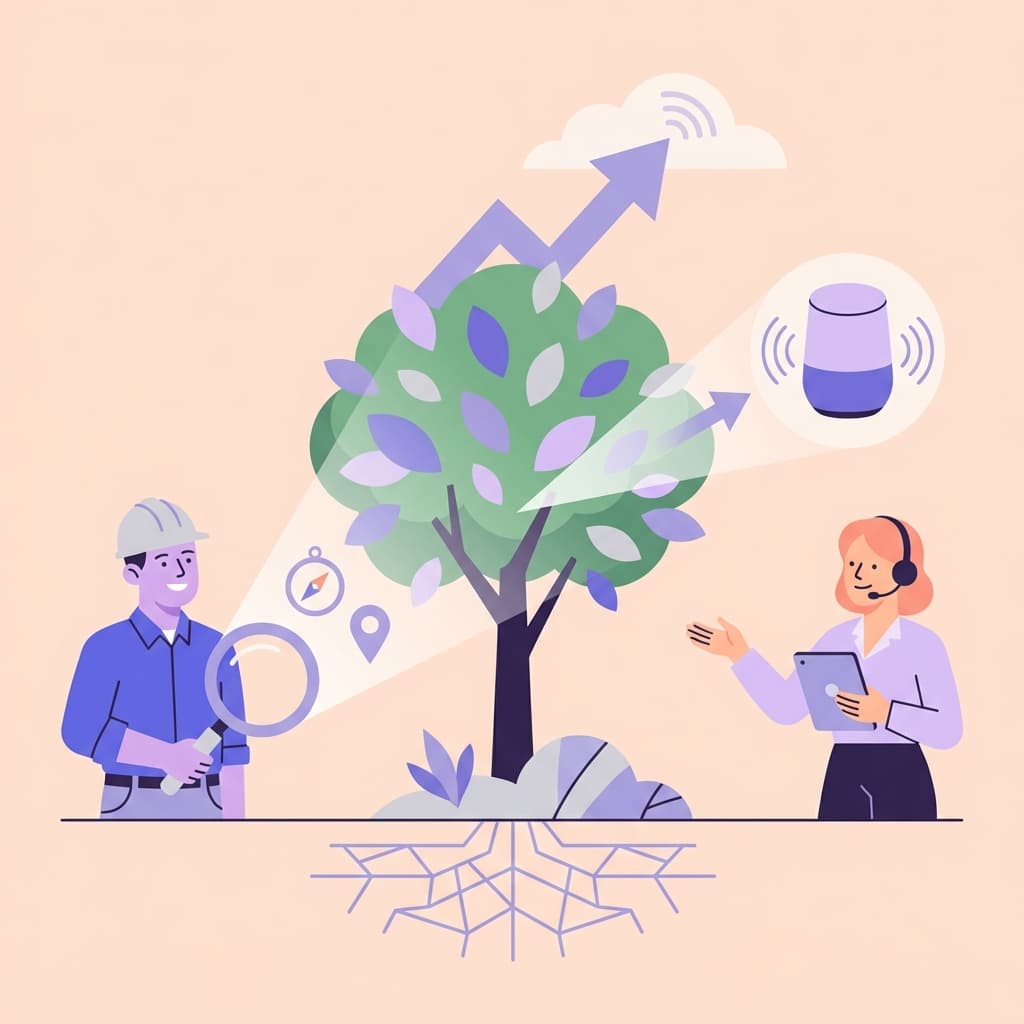
A homeowner stares up at a dead limb hanging over the roofline after a windy night. They don’t want a “good deal”, they want someone insured, qualified, and available before the next storm hits. Ten minutes later they’ve searched “tree removal near me,” skimmed the map results, and then asked an AI tool, “Who can remove a large tree close to my house and handle cleanup?” If you run a tree service business, that moment is exactly where SEO and AEO decide whether your phone rings, or your competitor’s does.
Two ways homeowners find an arborist now
Tree work is a trust-heavy, high-risk trade (and one of the most dangerous jobs in the country). That reality shapes how people search and how they choose.
- SEO (Search Engine Optimization) helps you appear when someone searches on Google (maps and regular results).
- AEO (Answer Engine Optimization) helps you get recommended when someone asks a question in ChatGPT, Google AI Overviews, Perplexity, and similar tools.
They overlap, but they don’t behave the same.
Is AI Recommending Your Business?
See how you stack up against your competitors and let Pantora get you to the top.
Getting seen on Google: what SEO actually means for tree services
SEO is the collection of steps that help your business show up when people search for the exact job they need. For tree services, that usually looks like:
- “tree trimming [city]”
- “tree removal near me”
- “stump grinding [neighborhood]”
- “emergency tree service after storm”
- “ISA certified arborist [city]”
- “tree too close to house removal cost”
Most local tree service SEO breaks into three areas:
1) Maps visibility (your Google Business Profile)
When someone searches from a phone standing in their driveway, the map results are often the first click, and sometimes the only click.
Your Google Business Profile (GBP) influences:
- Whether you appear in the top map listings
- Whether you look credible at a glance (photos, reviews, service list, hours)
- Whether people call you without ever visiting your website
2) Website rankings (service pages and helpful content)
Your site is still a major proof point. It’s where you can explain specialty work clearly, like crane-assisted removals, hazardous limb removals, or winter dormant pruning, and show job photos that build confidence.
3) Trust and consistency (reviews + accurate info)
Google is cautious about recommending risky services. A tree company with mismatched phone numbers, vague service descriptions, or thin reviews often loses to a competitor that looks more established, even if the crew quality is comparable.
Where AI recommendations fit in: AEO for arborists
AEO is about becoming the business that an AI system can confidently name when someone asks a question instead of typing keywords.
Examples of tree-service questions people ask AI:
- “Who is the best insured tree service near me for storm damage?”
- “Do I need an ISA certified arborist for tree trimming?”
- “What company can remove a big oak close to my house with a crane?”
- “Who does stump grinding and haul-away in [city]?”
The big difference in behavior:
- SEO puts you in a list.
- AEO tries to hand the homeowner an answer.
If an AI tool is going to recommend you, it needs clarity: what you do, where you do it, whether you’re legitimate, and why you’re a safe choice.
How AI tools decide which tree services to mention
AI systems pull from a patchwork of sources. It’s not perfectly transparent, but in practice they tend to “trust” businesses that have clear, consistent signals across the web.
Common inputs include:
- Your Google Business Profile (services, categories, reviews, photos, hours)
- Your website (service pages, FAQs, proof of insurance/certifications)
- Third-party platforms (Facebook, Yelp, Angi, Nextdoor, local directories)
- Mentions in local articles, neighborhood groups, “best of” lists, sponsorship pages
- Consistency of your name, address/service area, and phone number across listings
If your online presence is missing key details, the AI may fill in blanks, or simply avoid recommending you. For example, if you do emergency storm response but your GBP hours and services don’t mention it, you’ll get skipped when someone asks “who can come out tonight?”
For a deeper look at how different AI results work (and why they look inconsistent), see: ChatGPT vs AI Overviews vs Grok vs Perplexity: What's the Deal?.
The practical overlap (and the real differences) between SEO and AEO
Tree service owners often hear “AI” and assume they need to reinvent marketing. You don’t. You need to tighten the signals you already rely on, then make them easier for machines to interpret.
Here’s the clean way to think about it:
- SEO gets you discovered when the homeowner searches.
- AEO gets you chosen when the homeowner asks.
A few differences that matter in tree work:
Google maps still cares about distance
Proximity is huge for “near me” searches. If your yard is 25 minutes away, you can still win, but you need stronger quality and relevance signals (reviews, categories, service details, photos, and a site that matches the query).
AI cares about “defensibility”
An AI recommendation has to sound responsible. For tree services, that means you should be easy to describe as:
- “ISA certified arborist” (if true)
- “insured”
- “experienced with hazardous removals”
- “offers crane service for large removals” (if true)
- “includes haul-away/clean-up”
The click may disappear
With traditional SEO, many people click your site and then call. With AEO, someone might get your name and number directly in the response, then call immediately. That’s great, unless the AI never mentions you.
Tree-service specifics that move rankings and recommendations
Generic marketing checklists miss what homeowners actually worry about with trees: safety, property damage, and whether the crew will leave a mess. These are the details that tend to lift both SEO and AEO for arborists.
Create pages for the jobs people pay for (and the jobs they fear)
Homeowners don’t search “tree services.” They search the situation.
Build dedicated pages for the services you want more of, such as:
- Tree trimming / pruning (and clarify dormant pruning in winter)
- Tree removal (especially “close to house” or “large tree removal”)
- Stump grinding (mention depth expectations and restoration options)
- Emergency tree service (storms happen year-round)
- Tree health assessment / risk evaluation (especially if you have an arborist)
A strong page should include:
- Signs they need the service (dead branches, rubbing limbs, leaning trunk, fungus at base)
- What you’ll do on-site (inspection, rigging plan, drop zone, haul-away)
- What affects price (access, size, proximity to structures, debris removal, crane needs)
- A realistic range (many trimming jobs fall around $300–$1,000, removals often $500–$3,000 depending on complexity)
- Photos from real jobs (before/after, crane setup, stump grinding results)
This does two things at once: it helps you rank for specific searches and gives AI systems something concrete to summarize.
Put your trust signals in plain sight (not buried)
In tree work, trust isn’t a nice-to-have, it’s the product.
Make sure these are visible on your website and reflected in listings:
- ISA Certified Arborist credential (if applicable) and what it means
- Insurance (general liability and workers’ comp where applicable)
- Equipment capability for big jobs (bucket truck, grapple truck, crane partners, etc.)
- “Clean removal” language (haul-away, yard protection, debris cleanup)
Also remember a homeowner’s underlying motivation: mature trees can add 10–15% to property value. Position pruning and health assessments as protecting that value, without sounding salesy.
Reviews that mention the actual job outperform generic praise
A five-star review that says “great service” is nice. A review that says “removed a storm-damaged maple hanging over the garage and cleaned everything up” is a lead magnet.
When you request a review, prompt for specifics: “Would you mind mentioning what we did, like tree removal, trimming, stump grinding, or storm cleanup, and the city/neighborhood? It helps other homeowners know we’re the right fit.”
Those details improve:
- Keyword relevance for Google
- Confidence for AI tools matching you to a question (especially “close to house,” “emergency,” “cleanup,” “insured”)
Seasonal intent is real, match it with content
Tree service demand shifts with weather and seasons, so your marketing signals should match:
- Winter: dormant pruning, structural pruning, hazard limb removal (often easier scheduling)
- Storm events: emergency response, downed limb removal, roofline clearance
- Anytime: removals, stump grinding, risk assessments
If your business does winter pruning, say it clearly. If you offer storm response, show proof: photos, a dedicated emergency page, and updated hours/availability during major events.
A “doable” routine: what to improve without living on a laptop
You don’t need to become a marketer to win locally. You need a repeatable system.
In the next 7 days (60–90 minutes)
- Update your Google Business Profile services: list trimming, removal, stump grinding, emergency service, and tree health assessment (only what you truly offer).
- Add fresh photos: crew at work, equipment on-site, before/after, clean final yard.
- Request 5 reviews from recent jobs: especially removals near structures, storm work, and cleanups.
In the next 30 days (one half-day project)
- Build or upgrade one “money page”: for example, “Tree Removal in [City]” or “Emergency Tree Service in [City].”
- Add a short FAQ block: answer questions you hear constantly (permits, timing, cost drivers, “will it hurt the tree?”).
- Check listing consistency: your business name, phone number, and service area should match across major directories.
Over the next quarter (big lift, big payoff)
- Publish 2–3 problem-based articles: “Is my tree dangerous after a storm?”, “How to tell if a branch is dead,” “When is the best time to prune oak trees in [region]?”
- Create a simple review flywheel: one text template, one follow-up message, one person responsible weekly.
- Show proof of expertise: a credentials section, safety notes, and clear explanations of pruning standards (bad pruning harms trees, educate without insulting competitors).
If you want to track whether you’re actually being mentioned across AI platforms (not just ranking in Google), Pantora can monitor visibility and surface clear actions to improve your chances of being recommended.
How to tell whether AEO is already impacting your leads
Many tree companies won’t notice AEO until the pattern shifts. Watch for these signals:
- Callers say, “I asked ChatGPT who to call for tree removal near my house.”
- Website traffic dips, but calls stay steady (or become more “pre-qualified”).
- Prospects ask oddly specific questions like “Do you have an ISA certified arborist?” or “Will you haul everything away?” because the AI framed the decision criteria.
- You lose jobs to companies that look more “official” online (even if your crew is stronger).
If your lead flow is off and you’re not sure why, this is a useful companion: How Google AI Overviews Impact Local Businesses.
If you’re not showing up: the most common gaps for tree services
When a tree company is invisible in AI answers (and underperforming in maps), it’s usually not mysterious. It’s typically one of these:
- You’re too generic online: everything is “tree service” instead of distinct services like trimming vs removal vs stump grinding.
- Emergency response isn’t clearly stated: no emergency page, no service listed in GBP, no recent storm photos.
- Credibility details are missing: no mention of insurance, certifications, or safety practices.
- Reviews don’t describe real work: lots of stars, not much substance.
- Your service area is unclear: you say “serving the metro area,” but listings don’t match, and AI can’t confidently place you.
Pick one high-value service (like removal near structures or stump grinding), make it unmistakable on your site and GBP, then earn a handful of reviews that mention that service. That single combo often moves both SEO and AEO faster than “doing everything.”
When you treat SEO as visibility and AEO as recommendation, the path gets simpler: clarify what you do, prove you’re qualified, and make it easy for Google and AI tools to trust you with a dangerous job. That’s how local arborists keep the schedule full, storm season or not.