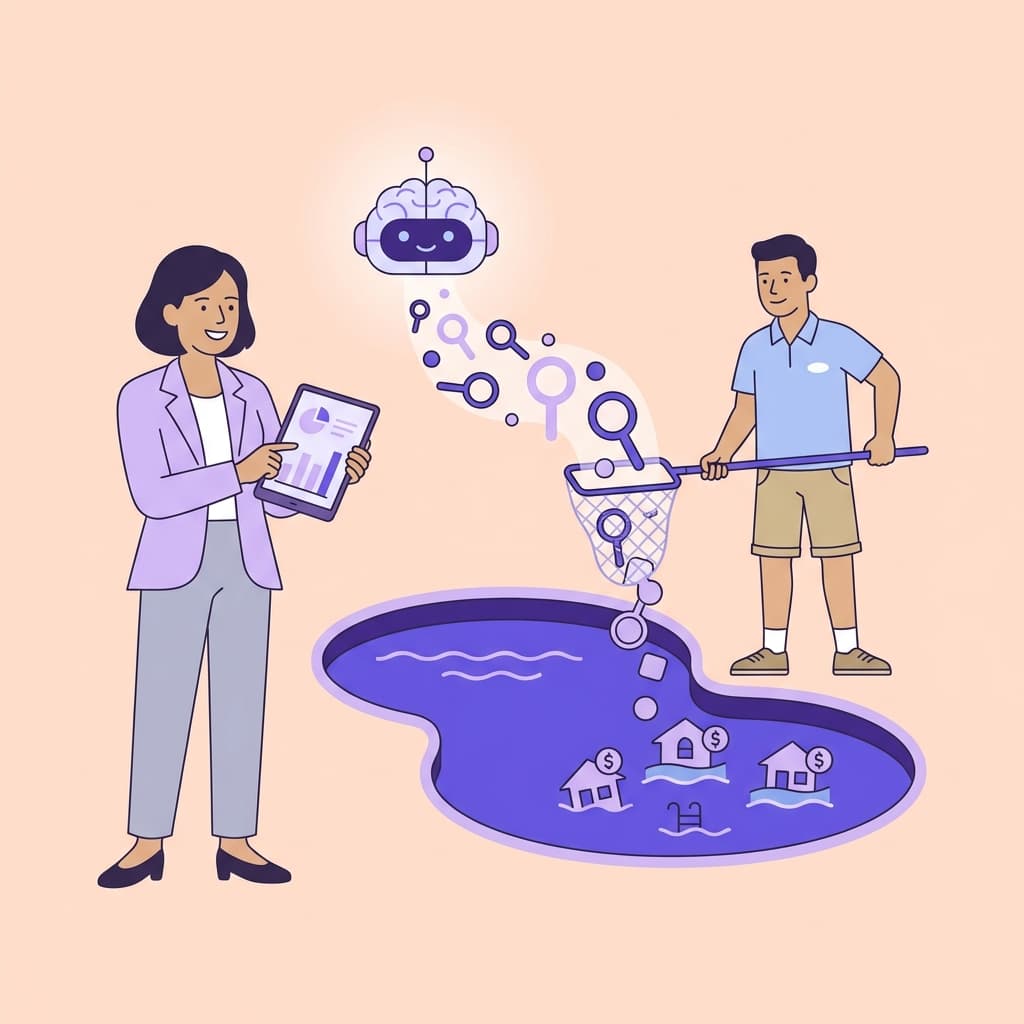
It’s 9:30 pm on a Thursday and someone walks into their backyard to find a pool that looks like pea soup. They’re hosting family this weekend, the water’s green, the pump is making a noise they’ve never heard before, and they’re not going to spend the next two days guessing at chemicals. What’s different now is what happens next: instead of asking a neighbor or scrolling through ten tabs, many homeowners ask an AI tool who to call.
If you run a pool service business, the goal is no longer just “rank on Google.” It’s to make it easy for AI tools to confidently recommend you for the exact problem (green pool recovery, weekly maintenance, heater repair, opening/closing) in the exact area you serve. That’s the kind of visibility Pantora is built to help with, so you can see what AI is pulling about your business and tighten up the signals.
Where AI-driven pool leads actually come from (and what the homeowner is really asking)
When a pool owner uses ChatGPT, Google AI Overviews, or Perplexity, they’re rarely asking generic questions like “pool company near me.” The prompts that create leads are more specific and higher intent, such as:
- “My pool is green, who can clear it fast near me?”
- “Weekly pool service cost in [Town] and who’s reliable?”
- “My pump won’t prime / filter pressure is high, who repairs pool equipment?”
- “Do salt pools still need maintenance? Who handles salt systems?”
- “Who can open my pool early this spring?”
- “Best pool company for closing + winterizing in the fall?”
AI answers are assembled from signals it can find, verify, and cross-check. For pool services, the strongest “recommendable” signals usually boil down to:
- Consistent business info across the web (name, address, phone, service area)
- Evidence you do the specific work (cleaning, chemical balancing, equipment repair, opening/closing, renovation)
- Proof of trustworthiness (recent reviews with job details, owner responses, photos)
- Clear scheduling expectations (weekly routes, response times, seasonal availability)
- Demonstrated expertise (CPO certification, chemical knowledge, equipment brands you service)
Where pool technicians lose is simple: their online footprint is vague. A site that just says “Pool Services” doesn’t help AI match you to “green pool recovery in 48 hours” or “Pentair pump repair.” And inconsistent listings (two phone numbers, old hours, missing service areas) reads like risk, so AI plays it safe and recommends someone else.
Is AI Recommending Your Business?
See how you stack up against your competitors and let Pantora get you to the top.
Make your business easy to “verify” online (before you try anything advanced)
You don’t need to overhaul everything to start getting AI-driven leads. You do need to remove uncertainty. Pool owners are inviting someone into their backyard and trusting them with expensive equipment, so your online presence should feel stable, current, and specific.
Tighten your Google Business Profile for pool-specific intent
Many pool companies set up a Google Business Profile once and never touch it again, right when competition heats up in spring.
Focus on:
- Categories that reflect what you actually want (pool cleaning, pool repair, pool maintenance, choose accurately)
- Service areas listed clearly (cities, neighborhoods, lake communities, HOA developments you route through)
- Services filled out with money-makers: weekly maintenance, green pool cleanup, pump/filter repair, heater troubleshooting, opening/closing, leak detection (if offered), salt system service
- Seasonal hours (spring openings, summer routes, fall closings) so “are they open?” doesn’t become a dealbreaker
- Fresh photos (real techs, trucks, equipment pads, before/after water clarity, filter cleanings, no stock images)
Seasonality matters in pool service more than most home services. If your listing doesn’t reflect your real availability, like “Book openings now” in March/April or “Closing calendar filling up” in September, AI will often recommend the company that looks more current.
Standardize your name/phone/address everywhere
AI pulls business facts from maps, directories, review sites, social profiles, and your website. If your Instagram has one phone number and your Google profile has another, you look disorganized, even if you do great work.
Quick rule: same NAP (name, address, phone) and same formatting across:
- Google Business Profile
- Facebook/Instagram
- Yelp and local directories
- Your website header and footer
Also watch for duplicates, pool companies commonly end up with an old listing from a previous owner, a warehouse address that customers can’t visit, or a service-area listing that conflicts with a storefront listing.
Put your route and reliability into words
Pool owners care about “Will they show up every week?” almost as much as “Can they fix it?” Make sure your site and profiles answer:
- Do you offer weekly scheduled service?
- Do customers get the same day each week (weather permitting)?
- Do you leave service notes (chem readings, what was adjusted, what to watch)?
- How fast do you respond to equipment-down situations?
AI can’t infer reliability. You have to state it.
If you want a broader view of how AI is reshaping local discovery, the 2026 AI Search Report: How Americans Are Using AI and What It Means for Your Business connects the dots.
Reviews that help AI recommend you (not just “5 stars”)
In pool services, reviews do more than boost conversions, they help AI understand what you’re known for. A review that says “Awesome service” is nice. A review that says “Cleared our green pool in two visits, explained chlorine vs phosphate, and fixed a leaking pump seal” is a ranking signal AI can actually use.
Ask at the moment the pool owner feels relief
For pool work, that moment is usually:
- When the water turns from cloudy to clear
- When the pump starts running quietly again
- When the heater kicks on and the season is saved
- When closing is done and they feel “winter-ready”
Send a simple text:
- “Glad we got your pool back in shape. If you have a minute, a quick review helps neighbors find us: [link]”
Encourage job-specific wording (without being awkward)
You’re not coaching a script, you’re steering toward useful detail.
Try:
- “If you mention what we helped with (green pool cleanup, weekly service, pump repair, opening/closing), it helps other pool owners.”
Respond like a pool professional, not a copy/paste robot
Owner responses signal that you’re active and accountable. They also let you sneak in helpful keywords naturally (“salt pool,” “CPO,” “variable-speed pump,” “chemical balancing”) without sounding salesy.
A solid response might mention:
- What you did (briefly)
- What the customer can expect next (follow-up visit, weekly maintenance plan, filter cleaning interval)
- A small educational point (pool chemistry protects plaster, liners, heaters, and pumps)
Industry fact worth using in your messaging: pool chemistry affects equipment life. When you say that publicly (in reviews, FAQs, and service pages), you position yourself as a technician, not just “a cleaner.”
Website pages AI can match to high-intent pool problems
Most pool service websites have a single “Services” page with five bullets. That’s hard for AI to recommend because it can’t confidently match you to a specific prompt.
Instead, build a few focused pages that mirror how pool owners ask for help.
Create pages for your best lead drivers
Common high-value pages for pool companies:
- Weekly pool maintenance (what’s included, routes, add-ons like filter cleans)
- Green pool cleanup / algae treatment (timeline expectations, what affects speed)
- Pool equipment repair (pumps, filters, heaters, automation, salt systems)
- Pool opening (what you do, what the homeowner should do before you arrive)
- Pool closing/winterizing (blowouts, antifreeze approach, cover options)
- Chemical balancing (especially if you offer “chem-only” plans or troubleshooting)
Add specifics that show real expertise:
- Pumps should typically run 8–12 hours daily (with context: weather, bather load, variable-speed settings)
- Salt pools still need maintenance (cells scale, pH drifts, stabilizer matters)
- What test methods you use (drop test vs strips), and why accuracy matters
Publish “What should I do right now?” troubleshooting content
These pages capture urgent searches and turn them into calls:
- “Pool is green after rain: what to do tonight vs what to leave to a technician”
- “Pump won’t prime: common causes (skimmer level, lid o-ring, clogged impeller)”
- “High filter pressure: when to backwash vs when to clean cartridges”
- “Cloudy pool before a party: realistic options in 24–48 hours”
Keep it practical, then end with a clear next step: “If you want a pool technician to diagnose this and get you swimming again, call/text/book.”
Add transparent pricing ranges (without boxing yourself in)
AI gets asked pricing constantly. If you never address it, AI will cite someone else.
Good pages include:
- “Weekly pool service cost in [Your Area]: what’s included”
- “Pool pump repair cost: what changes the price”
- “Pool heater repair vs replacement: typical ranges”
Use your real-world ranges:
- Maintenance: $100–$200/month (explain what moves it: pool size, debris load, chemical use, frequency)
- Repairs: $500–$2,000 (explain what moves it: pump vs motor, heater parts, automation diagnostics, labor time)
A practical 7-day plan to show up more in AI recommendations
If you want a straightforward sprint that improves AI visibility without turning into a marketing project, do this:
- Choose two “signature” services to push this month (example: green pool cleanups + weekly maintenance, or openings + equipment repair).
- Update your Google Business Profile services to match those exact phrases.
- Add 10 new photos (equipment pads, before/after clarity, tech at work, chemical testing, real and recent).
- Create one dedicated page per signature service with FAQs like “How fast can you clear a green pool?” and “Do salt pools need weekly service?”
- Request 5 reviews from recent customers and nudge them to mention the job type.
- Answer 3 common objections on your site: scheduling reliability, what’s included, and what happens when equipment fails.
- Check how AI tools describe your business and note inaccuracies (wrong service area, missing services, old phone number).
If you want help spotting the gaps faster, Pantora can surface where your business data is thin or inconsistent, so you spend your time fixing the signals that actually affect recommendations.
Why you’re not getting AI-driven leads (even if your work is excellent)
Pool companies often assume “we’re busy in summer, we’ll be fine.” Then spring openings hit, competitors flood the market, and the phones don’t ring like they used to.
If you’re not showing up in AI answers, it’s usually one (or more) of these:
- You look like a generalist with no proof. “We do pool services” doesn’t tell AI you handle green pool recovery, heater diagnostics, or salt systems.
- Your reviews don’t say what you do. Lots of stars, not much detail, or nothing recent since last season.
- Your service area is unclear. AI can’t recommend you for “near me” if it can’t tell whether you service that town/zip/HOA community.
- Your info is inconsistent. Old phone numbers, duplicate listings, or mismatched hours make you a risky recommendation.
- Your site doesn’t answer pool-owner questions. No pricing context, no “what to do now,” no seasonal pages for opening/closing.
If you want a deeper explanation of how to optimize for AI answers (not just classic SEO), start with AEO for pool services. And if your main goal is to appear directly in ChatGPT results, this guide is the most direct path: get your pool services business on ChatGPT.
The goal: become the safe recommendation for “green pool,” “weekly service,” and “pump repair”
AI isn’t replacing word-of-mouth. It’s replacing the moment where a homeowner asks, “Who should I call?” If your online presence clearly shows what you do, where you do it, and why you’re trustworthy (CPO certification, reliable scheduling, chemical and equipment expertise), you give AI everything it needs to choose you.
If you want a clearer picture of what AI tools are seeing, and a faster way to prioritize fixes, Pantora can help you tighten the signals that turn “someone asking a question” into “your next booked route stop.”