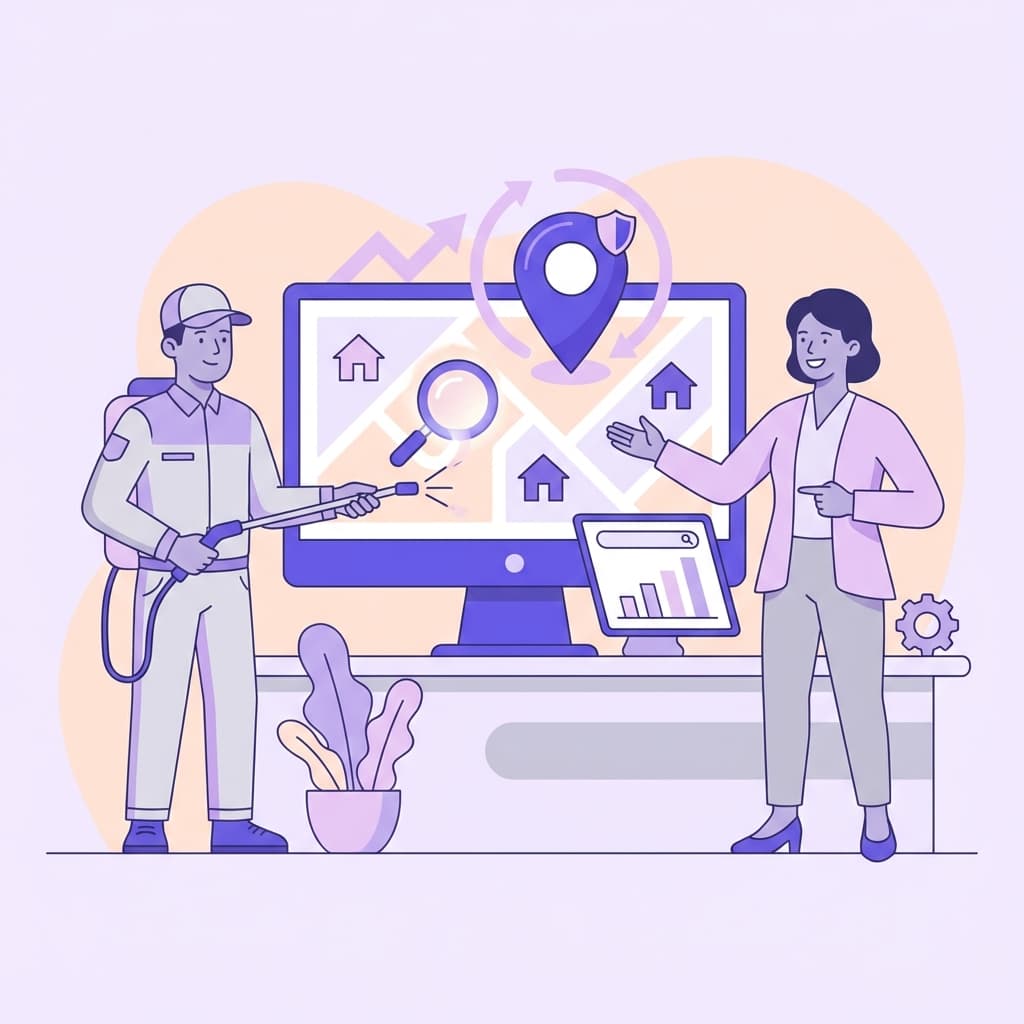
It’s 10:30 PM and a homeowner spots a roach sprint across the kitchen floor. They don’t “shop around.” They grab their phone and type something like “exterminator near me open now” or “roach treatment [city].” That’s where traditional SEO wins. But more and more, the same customer asks an AI tool: “Who’s the best pest control company near me that uses safe products and offers a guarantee?” When the AI responds with a short list (or one name), that’s AEO. If you run a local pest control business, you’ll get more booked inspections and recurring plans by understanding how these two channels overlap, and where they play by different rules.
Visibility on Google: the three places customers actually choose from
SEO (search engine optimization) is the work that helps your company show up when people search on Google. In pest control, those searches are usually problem-first and urgency-loaded, like:
- “termite inspection near me”
- “bed bug treatment cost [city]”
- “mouse droppings in attic who to call”
- “mosquito spraying service [neighborhood]”
- “wildlife removal raccoon in chimney”
When pest control technicians think “SEO,” they often think “website.” In reality, customers decide from three main surfaces:
-
The map results (Google Maps / local pack)
This is where most high-intent calls come from: the map, three listings, ratings, and tap-to-call. -
The regular results (website rankings)
Your service pages and posts show up here, especially for terms like “termite treatment [city]” or “how to tell if you have bed bugs.” -
Your reputation footprint (reviews + consistency)
Google is trying to avoid recommending a sketchy operator for a trust-heavy job. Your reviews, photos, and business details across the web act like proof.
If you feel like rankings are “random,” it’s usually because one of those three surfaces is weak or inconsistent.
Is AI Recommending Your Business?
See how you stack up against your competitors and let Pantora get you to the top.
AEO: getting picked when the customer asks an AI tool for “the best”
AEO (answer engine optimization) is about being the business an AI can confidently recommend when people ask questions in tools like ChatGPT, Google AI Overviews, and Perplexity.
Instead of showing a page of options, the AI tries to give a direct answer to prompts like:
- “Which pest control company near me does IPM and uses EPA-registered products?”
- “Who can handle both rodents and exclusion work in [city]?”
- “What’s the best company for bed bug heat treatment around [neighborhood]?”
- “Is there a pest control technician near me with a guarantee?”
The big mindset shift:
- SEO is competing to rank.
- AEO is competing to be the recommendation.
That recommendation only happens when the AI can verify (or strongly infer) key details: services, service area, legitimacy, trust signals, and real customer outcomes.
Why pest control is a perfect storm for SEO + AEO
Pest control decisions are driven by fear, urgency, and trust. A homeowner isn’t just buying a $150–$300 one-time service or a $40–$70/month plan, they’re buying peace of mind.
A few industry realities make clarity online especially important:
- Termites cause about $5B in damage annually, so people want someone credible fast.
- One mouse can produce up to 60 offspring in a year, so “I’ll wait” quickly becomes “now it’s an infestation.”
- Prevention beats reaction, which is why recurring plans and exclusion services sell when you explain them well.
AI tools tend to reward businesses that communicate those realities clearly, because it helps the AI “explain” why a homeowner should call you.
The overlap (and the differences) between SEO and AEO for pest control
Local SEO still cares about proximity and completeness
For map rankings, Google leans heavily on distance, relevance, and prominence. You can’t change where your customer is standing, but you can control whether Google understands:
- exactly what you do (termite, rodent, bed bugs, mosquito, wildlife, general)
- where you do it (cities, suburbs, service radius)
- whether you look active and credible (reviews, photos, updates)
AEO cares about “confidence”
AI recommendations skew toward businesses it can describe without guessing. If your website and listings clearly state “licensed applicator,” “IPM approach,” “EPA-registered products,” and “service guarantee,” the AI has safer language to use when recommending you.
AEO can reduce clicks (while increasing calls)
In classic SEO, people click, browse, then call. With AEO, a homeowner may get your name and number directly in the response and call without visiting your site. That’s great if you’re included, and brutal if you’re invisible.
If you want a deeper look at how these AI result types differ, this is a helpful explainer: ChatGPT vs AI Overviews vs Grok vs Perplexity: What's the Deal?.
The pest-control-specific assets that move rankings and recommendations
Create pages for pest problems, not just “services”
Homeowners don’t wake up wanting “pest control.” They want the specific thing gone and they want reassurance it won’t come back.
Strong sites in this industry usually have dedicated pages like:
- General pest control (ants, roaches, spiders)
- Termite inspection and treatment
- Rodent control + exclusion (seal entry points)
- Bed bug treatment (chemical, heat, or hybrid, whatever you actually offer)
- Mosquito control (seasonal programs, yard treatments)
- Wildlife removal (squirrels, raccoons, bats, where legal and offered)
On each page, answer what people are truly asking in the real world:
- Signs you have the pest (e.g., frass for termites, rub marks for rodents, bites + spotting for bed bugs)
- What the technician will do (inspection, identification, treatment plan, follow-ups)
- What affects price (size of home, severity, crawlspace/attic access, number of visits)
- What makes you safe to hire (licensed applicator, EPA-registered products, IPM, guarantee)
This helps standard rankings and gives AI systems clean language to summarize.
Use seasonality on purpose (instead of being surprised by it)
Pest demand shifts in predictable waves:
- Spring: ants and roaches spike as temperatures rise
- Summer: mosquitoes become the “backyard problem”
- Fall: rodents start looking for warmth and entry points
You can lean into that with timely service pages and content updates. Example: a fall-focused rodent page that explains exclusion, trapping, and sanitation, plus a reminder that one mouse can multiply quickly, will convert better than a generic “rodent control” paragraph buried on a services page.
Put trust signals where a scared homeowner can’t miss them
In pest control, trust signals aren’t optional. They’re conversion levers.
Make these obvious on your homepage, service pages, and Google Business Profile:
- Licensed applicator / certified technician language (be specific to your state requirements)
- EPA-registered products (and how you use them responsibly)
- IPM approach (inspection + targeted treatment + prevention)
- Clear guarantee (what it covers and for how long)
- Real photos: technician in uniform, branded truck, treatment setups (not stock images)
AI tools also pick up on these signals because they make your business “describe-able” in a recommendation.
Reviews: the easiest way to rank for the pests you actually want
Reviews don’t just make you look good, they add keyword-rich evidence that you do the work you claim.
A 5-star review that says “Great service” is fine. A 5-star review that says, “They found the entry point in the garage, sealed it, and set traps, no more mice in the pantry” is gold for both SEO and AEO.
To get more useful reviews, change your ask. After you solve the problem (when relief is highest), send a text like:
“Would you mind mentioning what we treated (ants/roaches/rodents/termite inspection) and the area of the home? It helps other homeowners find us.”
Over time, those specifics help you show up for “rodent control,” “termite treatment,” and “bed bug treatment” searches, without you writing a single word.
Business listings: where small inconsistencies quietly cost you calls
Pest control is crowded: national chains, strong regional operators, and independents. When competition is tight, messy listings can be the difference between top 3 and invisible.
Tighten up the basics:
- Same name, address, and phone everywhere (no variations)
- Correct hours (especially weekends, seasonal hours, or emergency availability)
- Accurate service area (don’t claim counties you can’t serve fast)
- Correct categories (pest control service, termite control, wildlife control, only what you truly offer)
The goal is simple: never force Google or an AI system to guess.
A practical cadence: what to do weekly, monthly, and seasonally
Every week (60–90 minutes)
- Upload new Google Business Profile photos from real jobs (truck, gear, team, inspection tools).
- Request 3–5 reviews from completed jobs, especially the services you want more of (termite, bed bugs, exclusion).
- Add one short FAQ to your top service page based on calls you got that week (e.g., “Do I have to leave the house during treatment?”).
Every month (half-day project)
- Improve or publish one money page (termite, rodent exclusion, bed bugs, mosquito).
- Audit your top listings: Google, Yelp, Facebook, and whatever directories rank when you search your brand.
- Add a short “What to expect” section that explains your process like a technician would, not a marketer.
Every season (the growth lever)
- Build a seasonal push page and supporting content:
- Spring: ant + roach prevention
- Summer: mosquito programs and timing
- Fall: rodent entry points and exclusion
- Update your GBP services and posts to match what people are actively searching right now.
How to know if AI answers are already influencing your leads
You don’t need fancy tools to notice the shift. Watch for patterns like:
- Customers saying, “Google’s summary said you were good for termites,” or “ChatGPT listed you.”
- Fewer website visits, but steady calls and form fills (AI is shortcutting the click).
- Prospects asking pre-framed comparison questions: “Do you do IPM?” “Do you guarantee bed bug treatments?” “Are your products safe for pets?”
If you want a more systematic way to see whether your business is being mentioned and recommended across AI platforms, Pantora can track visibility and highlight the gaps that keep you from showing up.
If you’re not showing up: the most common fixable gaps
When a pest control company is missing from map rankings or AI recommendations, it’s usually one (or more) of these:
- Your core services aren’t explicit. “Pest control” is vague; “termite treatment, rodent exclusion, bed bug treatment” is clear.
- You have reviews, but they’re generic. You need reviews that mention the pest and the outcome.
- Your trust signals are hidden. If you’re licensed, use EPA-registered products, and follow IPM, say it plainly.
- Your service area is inconsistent. Your website says one thing; your Google profile says another.
- Your site has thin pages. One “Services” page won’t compete against companies with dedicated termite/rodent/bed bug pages.
If you want a pest-control-specific walkthrough of getting discovered in AI tools, this resource is a strong next step: How to get my Pest Control Business in ChatGPT?
SEO and AEO aren’t separate worlds. For pest control technicians, they’re two paths to the same outcome: getting the call when a homeowner is stressed and ready to book. Make your services unmistakable, build pages around real pest problems, collect reviews that describe the work, and put trust signals front and center. That’s how you win on Google, and how you become the name the AI feels safe recommending.