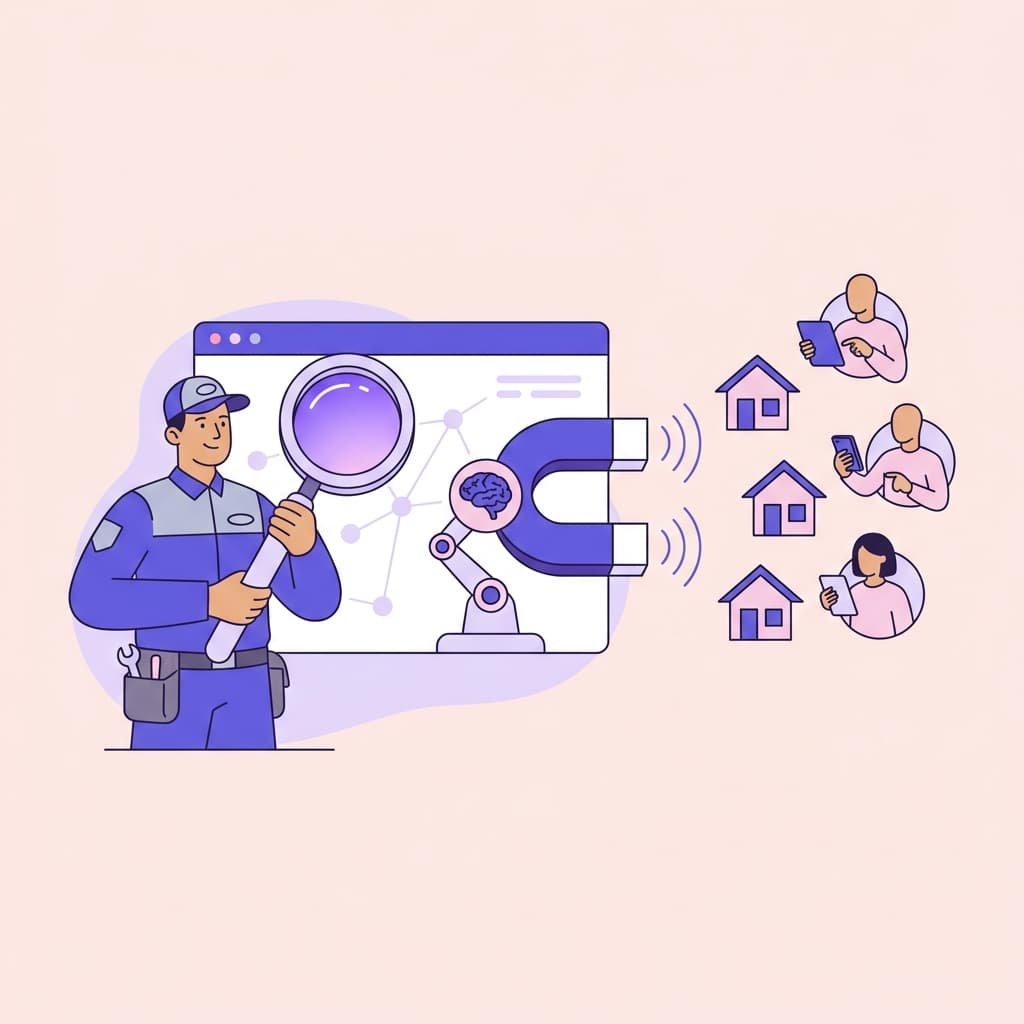
A homeowner spots tiny piles of sawdust near a baseboard and spirals: Is this termites? They don’t call the first pest control company they find anymore. Many people open ChatGPT or Google AI and ask, “Is this termite damage, and who can inspect today near me?” In that moment, the “lead” goes to the company the AI feels safest recommending.
If you want more booked inspections and recurring plans, you need to look credible, specific, and consistent across the sources AI reads. Tools like Pantora are built to help service businesses understand what AI is pulling about them, and what to fix so they show up more often.
Where AI-generated pest control leads actually come from
AI isn’t “running ads for you.” It’s summarizing the web and making a short list when someone asks for help. In pest control, those prompts tend to cluster into a few high-intent categories:
- Panic prompts: “I found a bed bug, who does bed bug treatment near me?”
- Prevention prompts: “Best monthly pest control plan in [City] for roaches and ants?”
- Seasonal prompts: “Why are ants suddenly everywhere in spring, and who can treat?”
- Damage-risk prompts: “How much is a termite treatment and who is licensed?”
- Comparison prompts: “Local pest company vs national chain, who’s better?”
When AI answers, it leans on signals it can verify quickly, like:
- Clear business identity (name/phone/address/service area match everywhere)
- Licensing and professionalism (licensed applicator, IPM approach, EPA-registered products)
- Proof you do the exact job (termite treatment is not “general pest”)
- Recent reputation signals (steady, detailed reviews, not just a pile from 2019)
- A website that explains process, guarantees, and what happens next
Where pest control companies lose is being “vague.” Lots of sites say We handle all pests! but don’t explain how you treat termites vs rodents vs bed bugs, what products are used (at a high level), or what the customer should expect on visit #1.
Is AI Recommending Your Business?
See how you stack up against your competitors and let Pantora get you to the top.
Get the basics tight (because AI is allergic to uncertainty)
Before you worry about advanced AI tactics, make sure your fundamentals are boringly consistent. AI systems reward clarity.
Make your Google Business Profile look like an operator, not a placeholder
If your Google Business Profile is missing details, AI sees a risk. Tighten these items:
- Categories: choose the most accurate primary category and relevant secondary ones (don’t guess)
- Services: list your real revenue drivers (termite treatment, rodent control, bed bug treatment, mosquito control, wildlife removal, general pest control)
- Service area: cities and neighborhoods you actually serve, especially if you’re competing with national chains
- Photos: real technician photos, truck, equipment, bait stations (non-sensitive), exterior termite work, team shots, avoid stock insects
- Hours + seasonal updates: rodents spike in fall, mosquitoes in summer, keep availability current
If you run multiple branches, avoid sketchy “virtual office” addresses. Suspensions and inconsistencies make you harder for AI to recommend.
Keep your NAP identical across the internet
AI pulls from map listings, directories, social profiles, and your own site. If you have “PestPro LLC” in one place and “Pest Pro Services” elsewhere, or two phone numbers floating around, you look unreliable.
Use one consistent Name / Address / Phone, and match formatting too (Suite vs Ste, Rd vs Road). It’s annoying, but it’s also one of the quickest wins.
Build proof pages for your top-ticket services (not a generic “Services” list)
Most pest control websites bury everything under one page and expect the customer to call. AI needs more structure so it can confidently match a query to your expertise.
If you want leads, create distinct pages (or detailed sections) for:
- Termite inspection & treatment (including what you look for, what a treatment involves, warranty/guarantee basics)
- Rodent control (inspection, exclusion recommendations, trapping vs baiting approach, follow-ups)
- Bed bug treatment (prep checklist, treatment options, timeline, what “success” looks like)
- Mosquito control (seasonality, yard inspection, recurring schedule, what affects results)
- Wildlife removal (species you handle, humane practices, required permits where applicable)
Also, don’t be shy about your differentiators: licensed applicators, an IPM approach, and use of EPA-registered products are exactly the kinds of trust signals homeowners ask about in AI tools.
For the bigger “why this works” picture, this guide on AEO for pest control connects the dots.
Reviews: the “social proof” AI can actually read
In pest control, reviews don’t just prove you’re nice. They reduce fear. People are anxious about bed bugs, embarrassed about roaches, and terrified of termite damage (and with termites causing $5B in damage annually, that fear is rational).
Here’s how to turn reviews into a lead engine:
Ask at the moment the customer feels safe again
Timing matters. The best asks happen when you’ve restored control:
- after you’ve identified entry points and set a rodent plan
- after the bed bug follow-up confirms activity is down
- after you’ve installed termite monitoring or completed treatment
A simple text works:
- “Glad we could help today. If you have a minute, a quick review helps neighbors find us: [link]”
Nudge for specifics (without sounding scripted)
AI learns from detail. “Great service” is fine. “Found where mice were entering near the dryer vent and explained exclusion options” is better. “Treated carpenter ants and followed up in two weeks” is excellent.
You can prompt customers like:
- “If you mention what we treated (ants, roaches, rodents, termites), it helps other homeowners find the right service.”
Respond like a real local business
Owner responses signal that you stand behind your work, especially when someone is choosing between a regional operator and a national chain. A short, professional response also helps future customers see your process and guarantee language.
If you’re trying to understand how AI tools are changing discovery overall, the 2026 AI Search Report: How Americans Are Using AI and What It Means for Your Business is a strong companion read.
Content that captures “I need help now” searches (without writing 50 blog posts)
You don’t need a media company. You need a handful of pages that match real homeowner questions and reduce uncertainty.
“What is this pest and what should I do next?” pages
These are perfect for AI-driven discovery because people literally paste their situation into a prompt.
Examples that convert well:
- “Signs of termites in a house (and when to schedule an inspection)”
- “Roaches in the kitchen: why they show up and how treatment works”
- “Found mouse droppings: what it means and what a technician checks”
- “Bed bug bites vs other bites: what to look for and how we confirm”
Keep them practical. Include what to do immediately, what not to do (common mistakes), and a clear CTA to book.
Pricing range pages that set expectations (and attract serious buyers)
Homeowners ask AI pricing questions constantly. If your site won’t talk about cost, AI will cite someone else who does.
Good, honest pages include:
- “Termite treatment cost in [City]: what changes the price”
- “Rodent control pricing: inspection, trapping, and follow-up visits”
- “Bed bug treatment cost: why DIY often fails and what a plan includes”
- “Monthly pest control plans: $40–$70/month, what you get”
You don’t need to promise an exact number. Explain the variables: infestation level, home size, access, species, number of visits, and whether exclusion work is needed.
Location pages that feel like you’ve actually worked there
If you serve multiple suburbs, create pages like “Pest control in [City]” that include:
- common seasonal pest patterns (ants/roaches in spring, rodents in fall, mosquitoes in summer)
- neighborhoods or landmarks (without overdoing it)
- service constraints (same-day availability windows, what “emergency” means)
- real photos from jobs (no customer info, no license plate closeups)
This is especially important because one mouse can produce 60 offspring/year, and people searching for rodent control often want speed and certainty more than a coupon.
A practical 7-day plan to win more AI recommendations
If you want traction quickly, run this one-week sprint:
- Pick two “money services” to emphasize (e.g., termite treatment + rodent control, or bed bugs + general pest).
- Update your Google Business Profile services to match those exact phrases.
- Create or upgrade two service pages with a short process section + FAQs + guarantee language.
- Request 5 reviews from recent customers and ask them to mention the specific pest/problem.
- Upload 10 fresh photos (technicians, truck, equipment, exterior work, real, recent).
- Check your NAP consistency on the top directories you’re listed on (and fix duplicates).
- Audit how AI describes you, what services does it associate with your business, and what’s missing?
If you want a faster way to see what AI tools are pulling and where your gaps are, Pantora can help you spot the issues that keep you from being recommended.
For additional tactics that translate across home services, this breakdown of AI lead generation for home services is worth bookmarking.
Why you’re not showing up (even if you’ve “done SEO”)
If you have a decent website and still feel invisible in AI answers, it’s usually one of these:
- You’re positioned as a generalist. “We do all pests” doesn’t help when the prompt is “best bed bug treatment near me.”
- Your termite/bed bug/rodent content is thin. AI prefers specificity: process, timelines, and what the customer can expect.
- Your review pattern looks inactive. A flood of old reviews with nothing recent reads like a business that’s not current.
- Your trust signals are unclear. Licensed applicator, EPA-registered products, IPM approach, and a written guarantee should be easy to find.
- Your service area is confusing. If you serve “the metro area” but don’t list the cities, you’ll miss “near me” prompts in adjacent suburbs.
- Bigger brands are easier to summarize. National chains often have tidy pages for each service, local companies win by being more specific locally.
If your goal is to show up specifically in ChatGPT-style recommendations, start here: get your pest control business on ChatGPT.
Make the next homeowner question point to you
People will always ask neighbors for referrals. What’s changing is that the “who should I call?” question is increasingly asked in AI tools first, especially when someone is stressed about bed bugs, worried about termites, or hearing scratching in the wall.
When your listings are consistent, your reviews describe real outcomes, and your website clearly explains termite, rodent, and bed bug processes, you become easier for AI to recommend, and easier for homeowners to trust.
If you want to tighten up your AI visibility without guessing, take a look at Pantora and use it to see exactly what’s helping (or hurting) your recommendations.