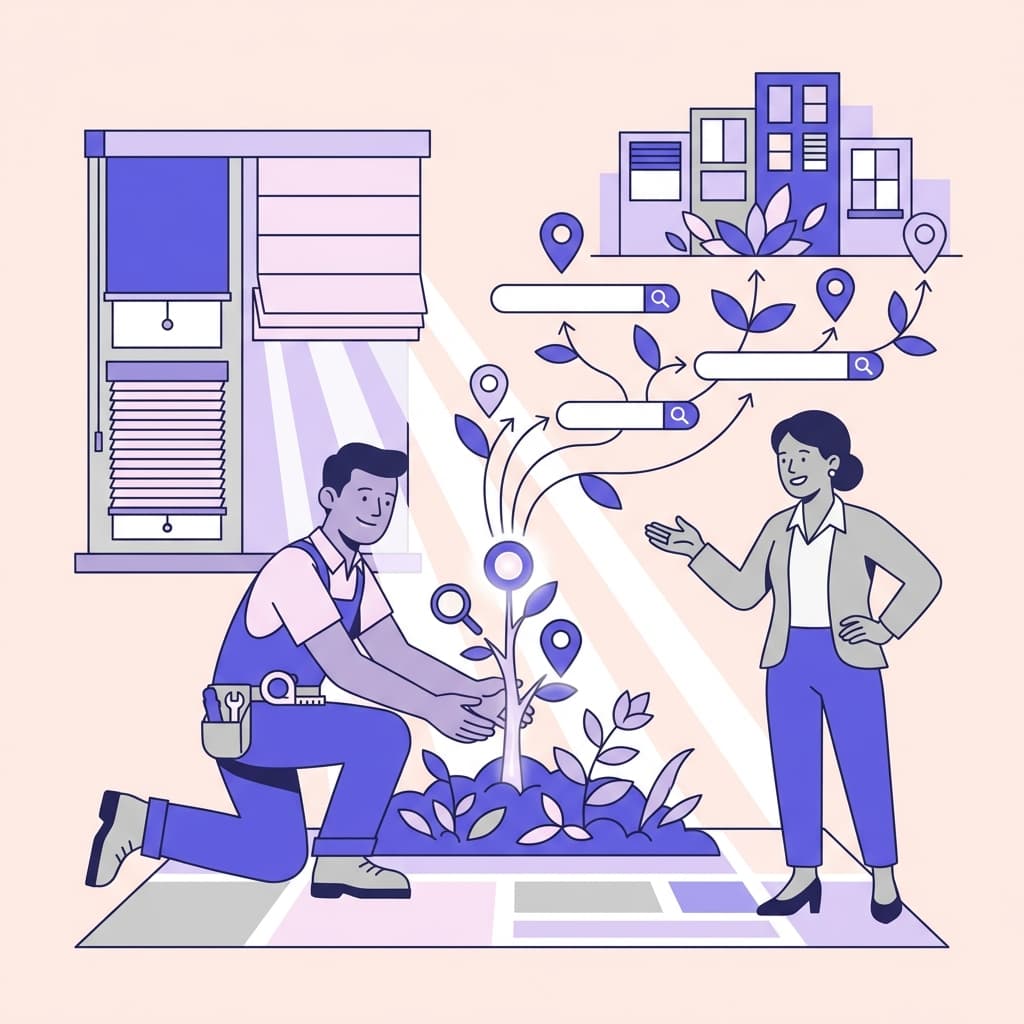
A homeowner is standing in their kitchen at 6:30pm, staring at a wide window that turns the room into a fishbowl at night, and they’re hosting friends this weekend. They don’t search “window treatments.” They search “privacy shades near me” or “blinds installation [city]” and they want someone who will measure correctly, show options in their home, and install without gaps. That’s where SEO gets you discovered. Now the same homeowner might ask ChatGPT or Google’s AI something like, “Who installs motorized shades near me and does free in-home consultations?” When the AI tool suggests a business (sometimes without the customer clicking a website), that’s AEO. If you run a local window treatments company, you need both working together.
Visibility today: two paths to the same customer
Think of modern lead flow as two lanes:
- Search engines (SEO): people type or tap a query and choose from results.
- Answer engines (AEO): people ask a question and expect a recommendation.
Your average job value ($500–$3,000) makes this a high-intent purchase, but it’s also comparison-heavy. Big-box retailers, online custom shade brands, and local showrooms are all competing for the same homeowner who wants privacy, light control, and an updated look. Winning comes down to being easy to trust and easy to match to the request.
Is AI Recommending Your Business?
See how you stack up against your competitors and let Pantora get you to the top.
SEO basics (in window treatments terms)
SEO (search engine optimization) is what helps your business show up when people search on Google (and maps) for what you do. In this industry, the searches tend to be tied to a room, a goal, or a product type, for example:
- “blinds installation near me”
- “cellular shades [city]”
- “plantation shutters installer [neighborhood]”
- “motorized shades cost [city]”
- “custom drapery installation near me”
For window treatment specialists, SEO typically comes from three main places:
1) Map results (Google Business Profile).
This is where “near me” searches often end. Your profile, reviews, photos, and service area settings matter a lot.
2) Website rankings (service pages and helpful content).
When someone searches “cellular shades vs roller shades” or “how to stop light gaps,” your site can earn the click, then the consultation.
3) Trust signals across the web (reviews, listings, mentions).
Google doesn’t just rank the closest company. It tries to rank the company it believes will satisfy the searcher.
The few SEO moves that pay off fastest
If you’re busy installing and only have bandwidth for the essentials, focus here:
- A dialed-in Google Business Profile: correct categories (e.g., blinds shop / window treatment store, installer), services listed (shutters, shades, drapery, motorization), updated hours, and jobsite photos.
- Clear service pages: not one “Window Treatments” page. Separate pages for blind installation, shade installation, shutter installation, drapery installation, and motorized shades.
- Consistent business info everywhere: same business name, address, phone, and website across directories (this reduces confusion for both Google and AI).
- Reviews that mention specifics: “custom measurements,” “child-safe cordless option,” “motorized install,” “no light gaps,” “on-time install.”
AEO explained: being the recommendation, not just an option
AEO (answer engine optimization) is the work you do so AI tools can confidently include you when someone asks:
- “Who installs motorized shades in [city]?”
- “Best window treatment specialist for privacy shades near me”
- “What company can measure and install shutters for a bay window?”
- “Who does child-safe blinds options and professional installation?”
Instead of returning a page of links, the AI tries to give a short list, or a single best match. That changes how leads are won. You’re not only competing on ranking; you’re competing on clarity.
Here’s the practical difference:
- SEO is earning a spot in results.
- AEO is earning a spot in the answer.
What AI systems tend to rely on for local recommendations
No platform is perfectly transparent, but in real life, answer engines pull heavily from:
- Your Google Business Profile (especially reviews, services, location/service area, photos)
- Your website (service pages, FAQs, pricing context, and proof you do the work you claim)
- Third-party sources (local directories, Yelp, Facebook, Nextdoor, Houzz in some markets)
- Mentions and citations across the web (community pages, “best of” lists, partners, builders)
- Consistency signals (matching phone numbers, addresses, and business names)
If something is unclear online, AI will either skip you or guess. For example: if you install motorized shades every week but your site only mentions “shades” in a general way, you can get left out when the question is specifically about motorization, one of the fastest-growing segments in the category.
If you want a deeper view of why this shift is happening and how AI results are changing local discovery, read: How Google AI Overviews Impact Local Businesses.
Where SEO and AEO overlap, and where they don’t
You don’t need two separate marketing strategies. You need one strategy that supports two different decision systems.
Google rankings still care a lot about “nearby”
For map results, proximity matters. If a homeowner searches from a specific zip code, Google often favors businesses that appear to serve that exact area (assuming reviews and relevance are strong).
AI cares a lot about “can I justify this recommendation?”
Answer engines try to recommend businesses they can describe. That means your online presence should spell out:
- What you install (blinds, shades, shutters, drapery, motorized options)
- Where you work (cities/areas served, and whether you do in-home consultations)
- Why you’re trustworthy (custom measurements, professional installation, child safety options, warranties if offered)
- What problems you solve (privacy, glare, heat control, light gaps, energy efficiency)
AI can send leads without the usual clicks
With traditional SEO, the customer often clicks your website, checks photos/reviews, then calls. With AEO, the customer may get your name and phone number directly from an answer and call right away. That’s great if you’re included, and brutal if big-box brands become the default suggestion because their presence is clearer.
Window-treatment-specific content that actually drives leads
Generic “do SEO” advice won’t help if it doesn’t match how homeowners shop for window treatments. Your customers are visual, detail-oriented, and sensitive to measurement mistakes. Use that to your advantage.
Build pages around how people buy (room + goal + product)
Homeowners rarely wake up wanting “window treatments.” They want an outcome:
- Privacy: top-down/bottom-up cellular shades, frosted options, lined drapery
- Light control: blackout cellular shades for bedrooms, layered treatments, shutters
- Energy efficiency: cellular shades (often the best insulation option), solar shades for heat reduction
- Updated look: modern roller shades, woven wood, custom drapery panels
- Convenience: motorized shades (especially for hard-to-reach windows or multi-window walls)
- Safety: cordless or child-safe options
Your website should reflect that buying language. Examples of high-intent service pages:
- Blind installation (mention leveling, mounting types, and clean finish)
- Shade installation (roller, cellular, solar; call out custom fit to prevent light gaps)
- Shutter installation (including specialty shapes, arches, bay windows)
- Drapery installation (rods, tracks, stacking space, lining options)
- Motorized shade installation (power options, app control, integration basics)
On each page, add a short section that answers the questions you hear in consultations:
- What’s included (measurement, ordering support, removal/disposal, install)
- What affects pricing (window count, fabric, motorization, specialty shapes)
- Typical timeline (consult → order → install)
- Warranty/maintenance basics
- Photos of real projects in real homes (not just manufacturer swatches)
This supports SEO (more relevant pages) and AEO (more “quotable” clarity).
Turn reviews into “proof of fit,” not just praise
You can’t write reviews for customers, but you can prompt them. After a successful install, text something like:
“If you can, mention what we installed (cellular shades, shutters, motorized roller shades) and what it helped with (privacy, glare, energy savings). It helps other homeowners find us.”
A review that says “Installed cordless cellular shades in nursery, perfect fit, explained child-safe options” is far more valuable than “Great job!”, for both Google ranking and AI matching.
Use trust signals that match this trade
Window treatments are deceptively technical. One bad measurement creates returns, delays, and unhappy homeowners. Make your trust signals obvious:
- Free in-home consultation (if you offer it) and what happens during it
- Custom measurements (and how you prevent measurement errors)
- Professional installation (and what you handle: mounting, alignment, programming motors)
- Child safety options (cordless, tension devices where applicable, guidance)
- Before/after photos showing light gaps reduced, glare controlled, cleaner finished look
Big-box retailers often compete on convenience and price. Your advantage is precision, guidance, and a finished result that looks custom, because it is.
A schedule you can stick to (without becoming a marketer)
Weekly (60–90 minutes)
- Post 3–5 new photos to your Google Business Profile (finished installs, close-ups of fit, motorized setups, shutters in specialty windows).
- Ask 3–5 recent customers for a review using a short prompt that includes the product and goal (privacy, blackout, energy savings).
- Add one small FAQ to a top service page (example: “Do cellular shades really help with insulation?”).
Monthly (2–4 hours)
- Build or upgrade one “money” page (motorized shade installation, shutters, or cellular shades).
- Audit your top citations: Google, Facebook, Yelp, and two local directories that show up when you Google your business name.
- Add one short case study to your site: “Problem → recommendation → installed result” with 4–6 photos.
Quarterly (half day)
- Create a repeatable review system (who asks, when, and what link/template you use).
- Refresh your service area language so your site and Google profile match where you actually do consultations.
- Add a comparison/education page that sells: “Cellular shades vs roller shades for energy efficiency” (this attracts research-stage homeowners before they choose a provider).
If you want to track whether your business is being mentioned and recommended across major AI platforms (and what to fix if you’re not), Pantora is built for that.
How to tell if AI answers are already influencing your leads
You’ll often notice it indirectly first:
- Prospects say, “I asked ChatGPT who installs shutters near me and you came up.”
- Calls increase while website traffic looks flat (AI can reduce clicks).
- People ask more specific questions upfront: “Do you do top-down/bottom-up?” “Can you program motors?” “Do you offer child-safe options?”
- You’re seeing more comparison shoppers who reference brands, not just styles.
If your calendar has open slots and you can’t pinpoint why, this is a useful companion: 5 Reasons Homeowners Aren’t Calling (and How to Fix It).
If you’re not getting found (or recommended), fix these gaps first
Most window treatment companies don’t have a “marketing problem”, they have a clarity problem. Check these:
- Your core services are buried: motorized shades, shutters, drapery installation should be obvious from navigation and headings.
- You’re missing the measurement story: homeowners fear mistakes. Say “custom measurements” prominently and show proof (process + photos).
- Your reviews are too generic: guide customers to mention the product type and outcome.
- Your business info conflicts across the web: different phone numbers, outdated hours, or mismatched addresses reduce trust signals.
- You look like everyone else: if you offer free in-home consultations, child safety options, or specialize in energy-efficient cellular shades, state it clearly and repeatedly.
One practical way to start: pick the service you want more of (often motorized shades or shutters), make a dedicated page for it, update your Google services to match, then earn 5–10 reviews that explicitly mention that service. That combination improves traditional rankings and makes it easier for AI to confidently match you to high-intent questions.
When you treat SEO and AEO as “make it easy to verify we’re the right fit,” you stop relying on referrals alone and start earning consistent consultations year-round, especially during new construction peaks and the seasonal push for energy savings before summer and winter.