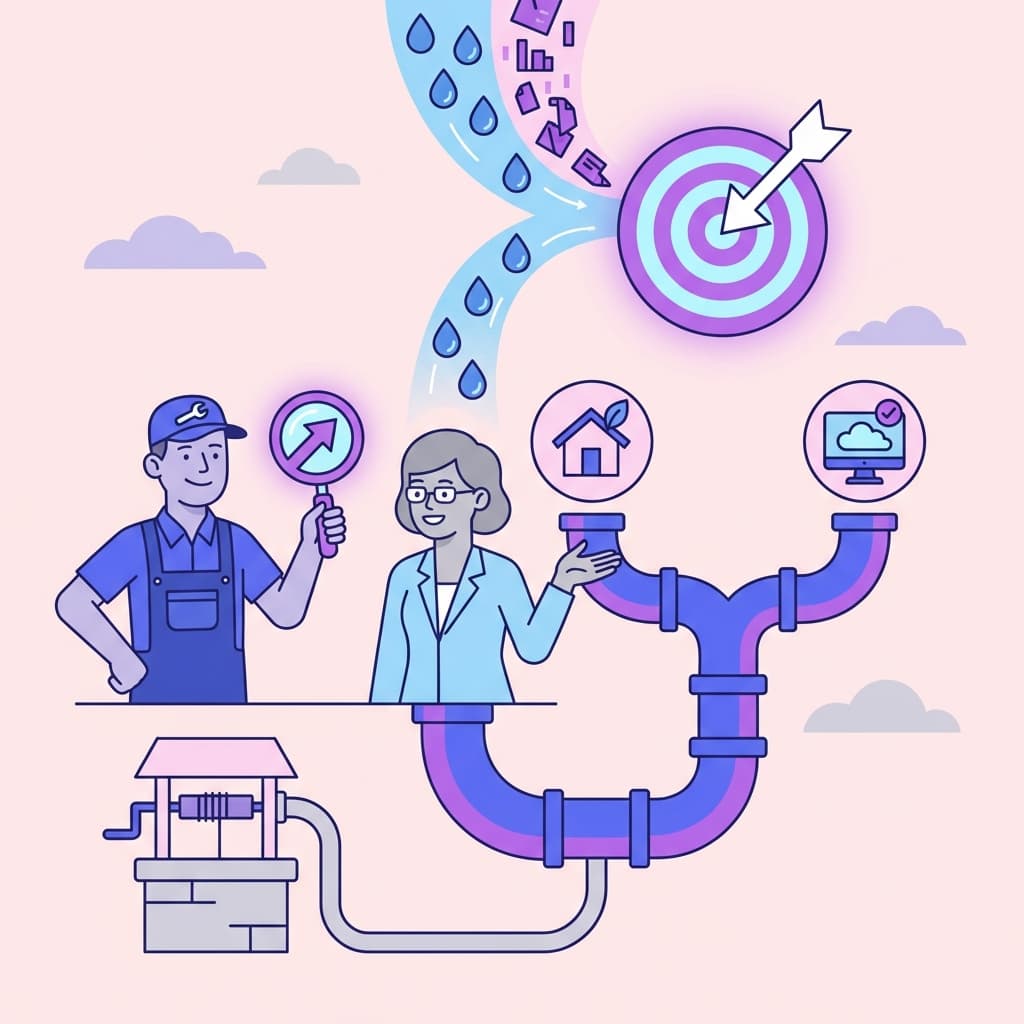
It’s 6:40 AM, a homeowner walks into the kitchen, and nothing comes out of the faucet. They don’t browse, they panic. Within 30 seconds they’re on their phone typing “no water well pump repair near me” or asking an AI tool, “Who can fix a well pump today in [town]?” If you run a well water services business, that moment is your entire marketing funnel. SEO is how you show up in search results when they look. AEO is how you get mentioned when an AI summarizes the best option and tells them who to call.
Private well customers are a distinct market (about 15% of U.S. households use private wells), and the buying triggers are intense: no water, low pressure, weird smell/taste, or a real estate deadline. That’s why visibility and trust signals matter more here than in many other home services.
Two ways homeowners “look you up” now
You’re competing in two discovery systems at once:
- Search engines (SEO): Google/Bing results, map listings, and the usual “near me” searches.
- Answer engines (AEO): AI answers in tools like ChatGPT, Google’s AI features, and Perplexity, where the customer may never click a website.
The good news: you don’t need two totally different marketing strategies. You need a clear, credible online footprint that both systems can understand.
Is AI Recommending Your Business?
See how you stack up against your competitors and let Pantora get you to the top.
Getting found on Google: what SEO means for well technicians
SEO (search engine optimization) is the work that helps your company appear when someone searches a problem, a service, or a local provider. In well water, that often looks like:
- “well pump repair [city]”
- “no water in house well”
- “pressure tank replacement near me”
- “well water testing for home sale”
- “new well drilling cost [county]”
- “low well water pressure causes”
For most well contractors and pump technicians, SEO breaks into a few practical pieces:
The map listing that drives calls
When someone searches “well pump repair near me,” they usually see a map and a short list of businesses first. Your visibility there comes mostly from your Google Business Profile: categories, service area, reviews, photos, and activity.
Website rankings for service pages (not just a homepage)
The “blue link” results still matter, especially for higher-value projects like new well drilling ($5,000–$15,000) or recurring services like annual water testing. Those searches often lead to more reading and comparison than a same-day pump failure.
Trust signals Google can verify
Google tries to reduce risk for the searcher. For well work, trust is tied to legitimacy and proof:
- Licensed well contractor (where applicable)
- Permits handled properly (especially for drilling)
- Emergency service availability for “no water” scenarios
- Water testing included or available (a huge differentiator)
If your online presence makes those items obvious, you tend to win more of the high-intent clicks and calls.
“Be the recommendation”: what AEO changes for local well businesses
AEO (answer engine optimization) is about making it easy for AI systems to confidently answer questions like:
- “Who is the best well pump repair company near me?”
- “Which well technician does emergency no-water calls?”
- “Who can do a well inspection and water test for a real estate closing?”
- “Who installs pressure tanks and can size them correctly?”
In an AI-first interaction, the customer may get:
- One recommended business, or
- A short list with quick reasoning (“licensed,” “offers emergency service,” “great reviews for pump repairs,” “serves [township]”).
A simple way to think about it:
- SEO helps you show up in a set of options.
- AEO helps you become the option that gets named.
Where AI pulls “confidence” from
AI tools aren’t all transparent, but in practice they lean on similar sources when identifying local service providers:
- Your Google Business Profile (services, hours, reviews, photos)
- Your website service pages and FAQs
- Third-party sites and directories that mention your company
- Consistent name/address/phone details across the web
- Evidence you’re real: job photos, recent reviews, clear credentials
If your site and listings don’t clearly state that you do well pump repair, pressure tank service, water testing, and well inspections, an AI may skip you even if those are your bread-and-butter jobs.
What “good visibility” looks like in well water (specifics that matter)
Generic SEO advice is everywhere. Here’s what tends to move the needle specifically for well technicians and well drillers.
1) Build pages around the problems people actually have
Well customers rarely search “well water services company.” They search symptoms, urgency, or a real estate requirement.
Instead of one catch-all services page, create focused pages such as:
- Well pump repair (including “no water” troubleshooting)
- Low water pressure diagnosis and repair
- Pressure tank replacement/service (and signs of a failing tank)
- Well inspection for home buyers/sellers
- Well water testing (annual testing and real estate testing)
- New well drilling (process, permitting, timelines, what affects cost)
On each page, include the details people need to decide quickly:
- Common causes (in plain language)
- What your visit includes (diagnosis, parts, testing options)
- Whether you provide emergency service
- What areas you serve
- Price factors and typical ranges (even a broad range helps reduce sticker shock)
- Photos from real jobs (not stock images)
This supports SEO (rankings), and it also gives AI systems structured, quotable information.
2) Make “annual testing” and “real estate testing” easy to understand
Industry reality: wells should be tested annually, yet many homeowners only test when something tastes off, or when they’re forced to during a home purchase.
If you offer water testing, don’t bury it. Spell out:
- What you test for (common contaminants vary by region)
- Turnaround time
- Whether you coordinate lab testing
- Whether testing can be bundled with an inspection
- What happens if results are abnormal (next steps, treatment options, referrals)
This is a common place where AI questions start (“Do I need a well water test before buying a home?”), and businesses with clear answers get recommended more often.
3) Use reviews that mention the exact work (pump repair vs. drilling)
You can’t control what customers write, but you can prompt specificity. After a successful job, especially a stressful “no water” call, send a review request that nudges detail:
“Would you mind mentioning what we fixed (well pump repair, pressure tank, low pressure diagnosis, or water testing) and your town? It helps other well owners find us.”
Why it matters in this industry:
- A $500–$2,000 pump repair decision is fast and emotional.
- A $5,000–$15,000 drilling decision is slower, research-heavy, and trust-heavy. Specific reviews help you show up for both types of searches and make you easier for AI to summarize accurately.
4) Put licensing, permits, and emergency availability front-and-center
Well work has regulatory and safety implications that homeowners don’t fully understand, but they know enough to be worried about “doing it right.”
Make these trust signals visible on your site and listings:
- Licensed well contractor status (and license number if customary in your state)
- “Permits handled” language for drilling and major work
- After-hours/emergency service policy for no-water calls
- Clear warranty or workmanship guarantee language
- Photos of your equipment, rig (if drilling), trucks, and team
AI tools love concrete qualifiers like “licensed,” “offers emergency service,” and “handles permits”, but only if they can find them.
How SEO and AEO behave differently in your market
Search results are still very “geo-sensitive”
For “well pump repair near me,” proximity matters. If you serve a large rural radius, make sure your service area is clearly defined in your Google profile and on your website. Otherwise, you may be invisible in outer towns even if you regularly run calls there.
AI results reward clarity more than proximity
When a homeowner asks, “Who can do a well inspection and water test for a closing next week?” the AI may prioritize the business that clearly states:
- They do inspections
- They include or offer water testing
- They serve that town/county
- They have recent reviews mentioning those services
Some leads will skip your website entirely
With AEO, a homeowner might get your name and number in the answer and call immediately. That’s great, unless the AI chooses your competitor because your services, hours, or credentials aren’t spelled out.
If you want a deeper look at how AI results are changing local visibility (and why some businesses see fewer clicks even when demand is stable), read: How Google AI Overviews Impact Local Businesses.
A practical action plan that fits between service calls
You don’t need a “content department.” You need consistent, high-signal updates that match how well customers search.
In the next 7 days (1–2 hours)
- Add 10 new Google photos: pumps, pressure tanks, control boxes, clean install shots, before/after pressure gauge readings (if appropriate), and your truck at a jobsite.
- Request reviews from 5 recent customers and ask them to mention the service (“well pump repair,” “no water,” “water testing,” “pressure tank”) and their town.
- Add a short FAQ block to your top page (often well pump repair). Include questions like:
- “What causes sudden no water on a private well?”
- “How long do well pumps last?”
- “Do you offer emergency no-water service?”
- “Do you replace pressure tanks?”
- “Do you provide water testing?”
Note: pump life is often 10–15 years, and mentioning realities like that (with caveats) builds credibility.
In the next 30 days (half-day project)
- Create one “money page” you’re missing, such as “Pressure Tank Service in [Area]” or “Well Inspection & Water Testing for Real Estate.”
- Tighten your service area language everywhere (website, Google profile, directories). Rural businesses lose leads when towns/zip codes aren’t explicitly included.
- Publish one problem-focused article based on what you hear weekly:
- “Low well water pressure: common causes and fixes”
- “No water from well: what to check before you call”
- “What a well inspection covers for home buyers”
In the next quarter (small system that compounds)
- Create a repeatable review process: one text template, one follow-up, one person accountable.
- Post one job update per week to your Google profile (a short write-up + photo).
- Standardize your service descriptions so they match across your site and listings (pump repair, drilling, testing, pressure tank service, inspections).
If you want to monitor whether AI tools are actually mentioning your company (and what to change if they aren’t), Pantora can track your visibility across AI platforms and translate it into a concrete to-do list.
How to tell if AI recommendations are already affecting your calls
In many markets, this is happening quietly. A few signs you’re feeling AEO shifts:
- Callers say things like “My neighbor asked ChatGPT and it suggested you,” or “Google’s summary listed you.”
- You notice fewer website form fills, but phone calls stay steady.
- Prospects arrive “pre-qualified” with specific questions: “Do you include water testing?” “Are you licensed?” “Can you handle permits for a new well?”
- Larger competitors with more reviews and clearer positioning start showing up more often, even if you’ve been the local go-to for years.
If you’re not showing up: the most common fixable gaps
When a well business gets overlooked online, it’s usually not because the work quality is poor. It’s because the online signals are incomplete.
Check these first:
- Your primary services aren’t explicit (pump repair, drilling, testing, pressure tank, inspections).
- Your “emergency/no water” positioning is unclear (or missing).
- You have reviews, but they’re vague and don’t mention the actual job type.
- Your service area is too generic (“serving the tri-county area”) without listing towns/zip codes.
- Your trust markers are hidden (license, permits, testing options, warranty).
Pick one profitable service you want more of (often pump repair or real estate testing), build a strong page for it, align your Google services, and collect a handful of reviews that mention that exact work. In well water, that combination is often enough to change your visibility within weeks.
When you treat SEO and AEO as “make it easy to find us and easy to trust us,” marketing gets simpler. Your best jobs come from the moments when homeowners need answers fast. Your job is to be the business that Google can rank, and the one an AI feels safe recommending.