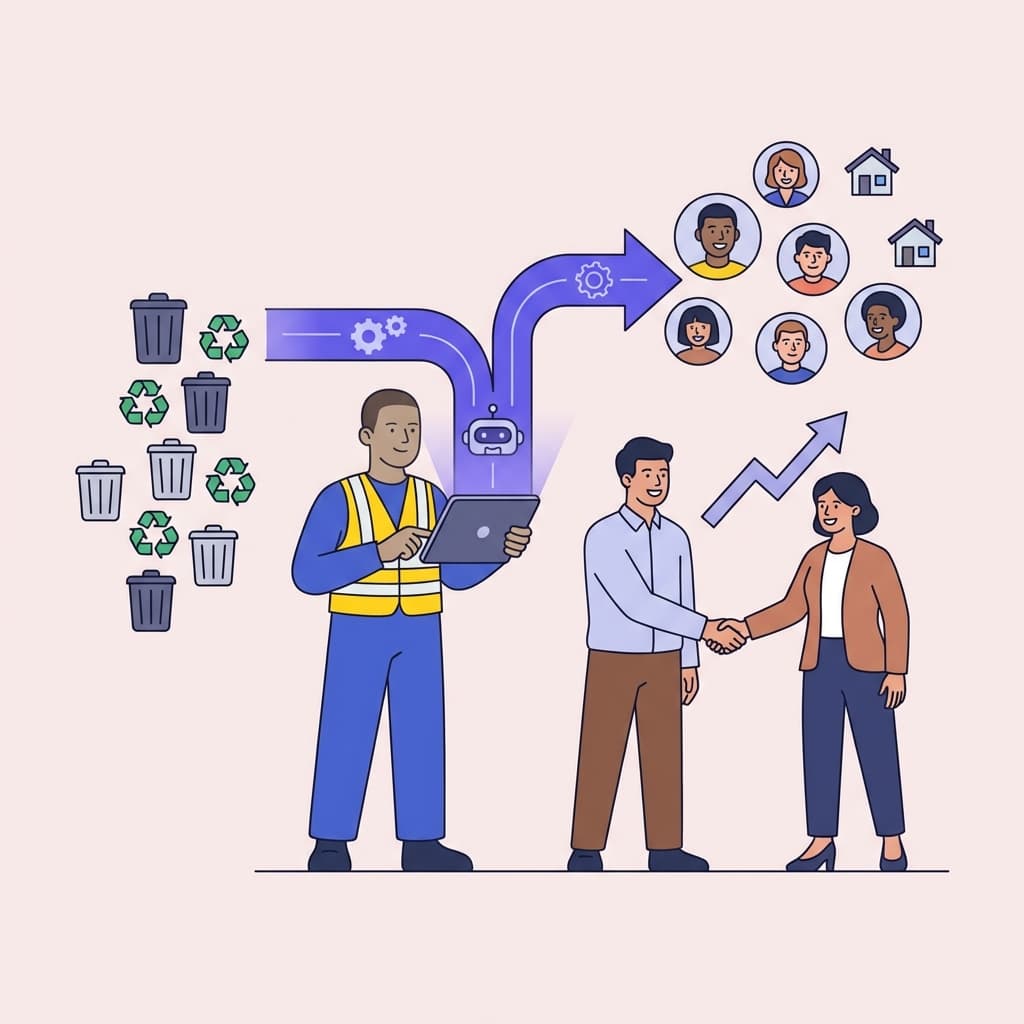
It’s Saturday morning in peak moving season. Someone just tore out old carpet, broke down a few bookshelves, and now they’re staring at a driveway full of debris. They don’t want to call five haulers to “see who picks up.” They open ChatGPT or Google, type “best 20-yard dumpster rental near me, delivered Monday”, and pick from the handful of companies the AI feels safe recommending.
That shift is the opportunity. If you’re a waste management professional, AI can become a steady source of calls for dumpster rental, recycling services, and construction debris removal, if your business is easy for AI to verify. Tools like Pantora are built to help you see what AI tools “think” about your company and where your online presence is costing you leads.
The new “referral”: where AI recommendations come from in waste management
AI-driven leads usually show up in a few predictable moments. Notice how often the questions include size, rules, and logistics, the core of dumpster rental decisions.
- Right-size prompts: “What size dumpster do I need for a kitchen remodel?”
- Availability prompts: “Who can drop off a roll-off container this week?”
- Compliance prompts: “Do I need a permit for a dumpster on the street in [City]?”
- Price-clarity prompts: “What’s the cost for a 10-yard dumpster with a 2-ton limit?”
- Recycling prompts: “Who recycles construction debris near me?”
When AI answers those, it pulls from signals it can find and trust, such as:
- Consistent business info across the web (name, address, phone, service area)
- Clear service descriptions (dumpster sizes in cubic yards, rental periods, weight limits)
- Recent reviews that mention the specific job (e.g., “30-yard for roofing tear-off”)
- Straightforward policies (what’s prohibited, what triggers overage fees)
- Proof of legitimacy (permits handled, licensed/insured where applicable, responsible disposal and recycling commitments)
Where many local haulers lose: their online info is vague or inconsistent. If AI sees unclear pricing, missing size details, outdated service areas, or a review profile that looks dormant, it plays it safe and recommends a national brand, or a competitor with cleaner info.
Is AI Recommending Your Business?
See how you stack up against your competitors and let Pantora get you to the top.
Make your online footprint “AI-readable” (the unglamorous fixes that win)
Before you publish new content or experiment with AI tools, tighten the basics. In waste management, small details matter because customers worry about surprise charges and prohibited materials.
1. Treat your Google Business Profile like your dispatch board
If your Google Business Profile is thin, AI has nothing solid to cite.
Focus on:
- Categories that match what you actually sell (dumpster rental, waste management service, recycling center/services, choose carefully based on your offerings)
- Service areas you truly cover (cities, townships, neighborhoods; don’t overreach)
- Service list details (10-yard / 15-yard / 20-yard / 30-yard roll-offs, commercial waste services, construction debris removal, recycling services)
- Photos that reduce risk (your trucks, containers, clean drop-offs, clear signage, team shots, avoid stock images)
- Hours + holiday/same-day notes (AI punishes uncertainty, keep it current during busy seasons)
If you use multiple yards or offices, don’t create sketchy listings. Suspensions can wipe out visibility fast.
2. Standardize your business info everywhere (and don’t forget the “small” fields)
AI cross-checks. If your website says one phone number, a directory shows another, and your Facebook page has an old address, you look unreliable.
Make sure your:
- Name / address / phone are identical (including “Suite” vs “Ste” formatting)
- Service area language is consistent (e.g., “serving Greater Dayton” vs a random set of cities)
- Key policies match across platforms (rental period, weight limits, same-day availability)
3. Turn “we rent dumpsters” into specific, searchable services
A single generic “Services” page won’t carry you in AI results. AI is trying to answer specific prompts like “best 20-yard dumpster for remodel debris”.
Create dedicated pages (or strong sections) for your biggest lead drivers, such as:
- Dumpster rental (by size: 10, 15, 20, 30, 40-yard, if offered)
- Roll-off containers for construction debris
- Commercial waste services (front-load, scheduled pickups, compactor solutions if applicable)
- Recycling services (what you accept, how you sort, how drop-off works)
- Cleanouts (estate cleanouts, moving cleanouts, storage unit cleanouts)
Then add the details customers always ask about:
- Typical projects per size (10-yard for garage cleanout, 20-yard for flooring + small remodel, 30-yard for major renovation, etc.)
- Weight limits and what happens if they exceed (this is a major pricing trigger)
- What can’t go in (tires, batteries, paints/chemicals, appliances, list your rules clearly)
- Placement guidance (driveway vs street, and who handles permits if needed)
If you want a deeper explanation of how AI reads your website and listings, start here: What is SEO and AEO for Waste Management Professionals?.
Reviews that actually produce dumpster rental leads (not just “5 stars”)
In waste management, people are anxious about three things: on-time delivery, no surprise fees, and clean, professional pickup. Your reviews should reflect that, because AI looks for patterns.
Ask at the moment they’re most relieved
The best time to request a review is right after:
- The container is picked up and the driveway looks normal again
- A renovation deadline was met (container delivered/picked up as scheduled)
- A customer avoided a permit headache because you guided them correctly
A simple text works:
- “Thanks for choosing us for your dumpster rental. If you can leave a quick review and mention the dumpster size/project, it helps a lot: [link]”
Nudge customers to include the specifics AI cares about
“Great service” is nice, but it doesn’t train AI to recommend you for the next customer’s query.
Encourage details like:
- Size: “20-yard roll-off”
- Project: “bathroom remodel debris” / “roofing tear-off”
- Outcome: “on time,” “clear pricing,” “no hidden overage surprises,” “helped with permit questions”
- Professionalism: “clean container,” “careful on driveway,” “quick pickup”
Respond like a real operator, not a template
Owner responses signal that your business is active and accountable. If a review mentions weight overages or prohibited materials confusion, respond with clarity, future customers (and AI) see that you handle issues professionally.
Use AI to publish the pages customers keep asking for (without becoming a content factory)
You don’t need weekly blog posts forever. You need a handful of pages that match high-intent questions in your market, especially during spring cleaning and construction season.
Here are content formats that work extremely well for waste management:
“Pick the right dumpster” pages
These capture right-size searches:
- “What size dumpster do I need for a kitchen remodel?”
- “10-yard vs 20-yard dumpster for a garage cleanout”
- “What fits in a 30-yard roll-off? (Examples + common projects)”
Include practical visuals or bullet lists, and mention that dumpster sizes are measured in cubic yards so customers don’t feel talked down to when they’re confused.
Pricing expectation pages that explain weight limits clearly
People ask AI for cost ranges constantly. If you refuse to talk about pricing, AI will quote someone else.
Strong examples:
- “Dumpster rental cost in [City]: what changes the price”
- “How weight limits affect dumpster pricing (and how to avoid overages)”
- “Construction debris removal pricing: what’s included vs extra”
You don’t need to publish a perfect quote, publish a trustworthy range and explain the variables: size, rental period, tonnage included, material type, distance, and permit requirements.
“Can I throw this away?” pages (prohibited materials = lead killer if unclear)
This is where local haulers can beat national companies with clarity:
- “What you can’t put in a dumpster (and what to do instead)”
- “Disposing of mattresses/appliances/yard waste in [County]”
- “Concrete, dirt, and brick disposal: why weight matters”
This reduces disputes, improves customer experience, and increases conversion because people feel safe booking.
A 7-day action plan to show up more often in AI results
If you want a simple, non-overwhelming plan, do this in order:
- Pick two “money” services to emphasize this month (e.g., 20-yard remodel dumpsters + contractor roll-offs).
- Update your Google Business Profile services to match those exact terms customers use.
- Create/upgrade one page per service with: sizes (cubic yards), rental periods, weight limits, prohibited items, and FAQs.
- Request 5 reviews from recent customers and ask them to mention size + project type.
- Add 10 new photos (containers, trucks, clean placement, before/after area, team).
- Check your listings for inconsistencies (phone/address/service area) and fix duplicates.
- Search yourself in AI tools (ChatGPT, Google AI results) for “dumpster rental near me” and “20-yard dumpster [city].” Write down what’s missing.
If you want a fast way to identify what AI is seeing (and what it’s not), Pantora can help you spot gaps in your AI visibility without guessing.
For extra context on how AI-driven discovery is changing consumer behavior, this is worth reading: 2026 AI Search Report: How Americans Are Using AI and What It Means for Your Business.
Why you’re not getting recommended (even if your website looks “fine”)
If leads are slow, it’s often not because you’re a bad company, it’s because your online signals are hard for AI to interpret confidently.
Common causes in waste management:
- You sound generic. “We handle all your waste needs” doesn’t prove you’re the right fit for a 30-yard construction container with a 3-day turnaround.
- Your policies are unclear. If weight limits, prohibited materials, or rental periods are hard to find, AI assumes higher customer risk.
- Your reviews don’t mention the job. Lots of “great service” reviews, few that include size/project/on-time delivery.
- Your service area is fuzzy. You may serve the whole metro, but if it’s not spelled out consistently, AI won’t connect you to “near me” queries.
- You’re missing trust signals. In this industry, customers watch for permit guidance, recycling commitment, and clear pricing. If those aren’t visible, AI tends to default to bigger brands.
If being cited in ChatGPT is a priority, this guide will help: get your waste management business on ChatGPT.
Make it easy to choose you, before they ever call
AI isn’t replacing relationships or contractor referrals. It’s replacing the moment when a stressed homeowner, property manager, or GC asks, “Who should I use?” If your business info is consistent, your services are spelled out in real-world terms (cubic yards, weight limits, rental periods), and your reviews include job details, you become the easiest recommendation.
If you want to tighten up how your company appears across AI search and recommendation tools, take a look at Pantora. It’s built to help service businesses get found, and chosen, when customers start their search in AI.