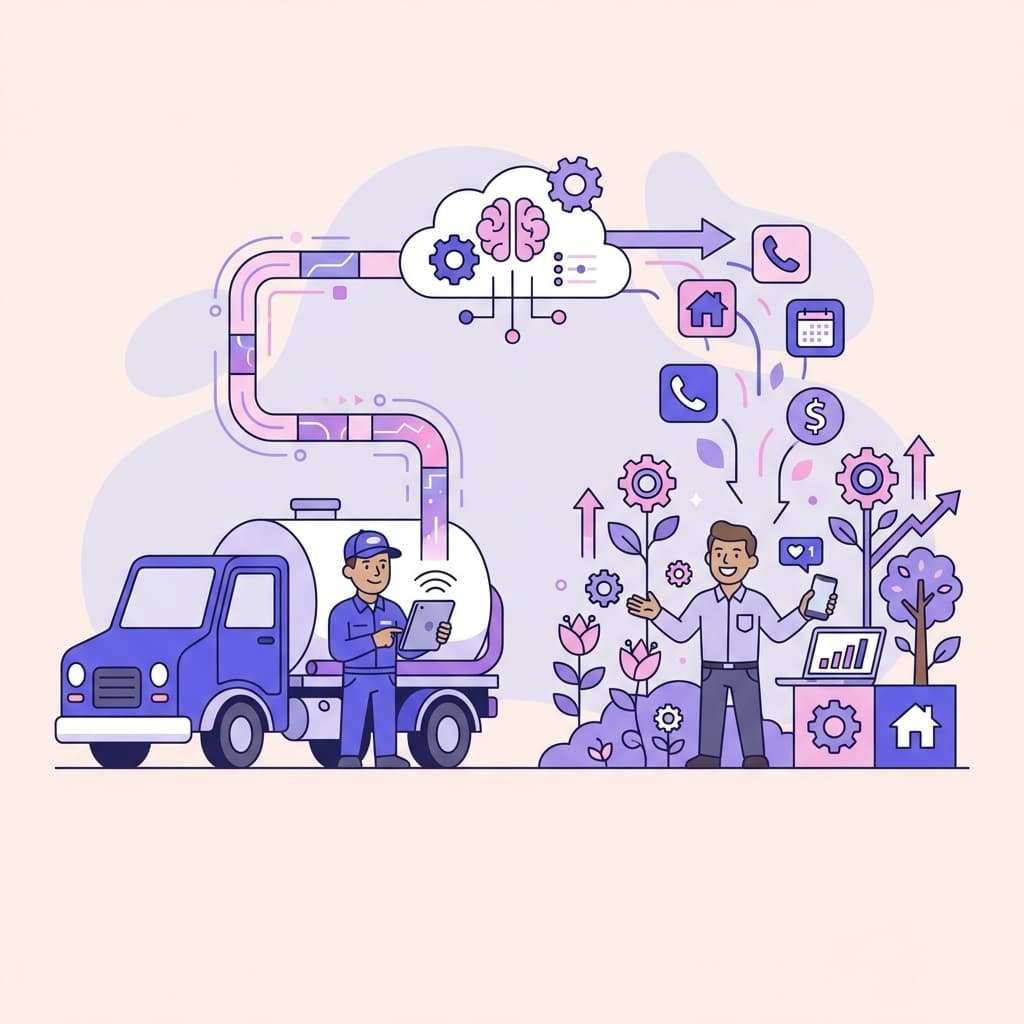
A homeowner walks outside and notices a soggy patch of grass that wasn’t there last week. The drains are slow, there’s a sewage smell near the back patio, and suddenly the “maybe next month” pumping turns into “who can come this week?” The twist in 2026 is that many homeowners don’t start with Google Maps or a neighbor anymore, they ask ChatGPT, Google AI, or Perplexity who to call.
If you want more septic pumping, inspections, and high-ticket repair leads, you need your business to be easy for AI to recommend with confidence, not just “present online.” That’s exactly what Pantora is built to help service businesses do, show up in the AI answers that are replacing a lot of the old discovery path.
Where AI-driven septic leads actually come from
Most septic leads generated by AI tools happen in a few predictable moments, usually tied to urgency, real estate deadlines, or “I need a price range before I call.”
Here are common prompt patterns that turn into booked jobs:
- Symptom-based prompts: “Slow drains and a septic smell, who should I call near me?”
- Real estate prompts: “Need a septic inspection for a home sale in [town]. Who’s licensed?”
- Prevention prompts: “How often should I pump my tank? Who does septic pumping in [city]?”
- Cost + trust prompts: “What does septic repair cost, and which company disposes properly?”
- Specialty prompts: “Who does camera inspection for septic lines near me?”
AI answers are assembled from signals it can find repeatedly across the web. In plain terms, it’s looking for proof that you’re real, local, and qualified to do the specific septic job being asked about.
For septic companies, the strongest “AI trust” signals tend to be:
- Clear licensing/credential language (where required)
- Evidence of proper disposal and compliant practices
- Reviews that mention the exact service (pumping, inspection report, baffle repair, drain field repair)
- A website that explains your process and what the homeowner should expect
- Consistent service area coverage (cities, counties, and “near me” alignment)
- Photos that look like real work (truck, crew, risers, lids, excavation, no stock-only vibe)
When a septic technician loses the lead, it’s usually because the online footprint is vague or inconsistent, different phone numbers across listings, a thin “Services” page, no inspection details, or old reviews that don’t reflect what you do today.
Is AI Recommending Your Business?
See how you stack up against your competitors and let Pantora get you to the top.
Get your local footprint “recommendable” (before you do anything fancy)
You do not need to chase every new AI platform. Start by tightening the basics that AI systems repeatedly pull from. If those are messy, the algorithm plays it safe and recommends someone else.
Make your Google Business Profile match what people request
Septic is often searched in moments of stress. Your profile needs to remove doubt.
Focus on:
- Primary/secondary categories that accurately reflect septic work (not general plumbing unless you truly are)
- Service areas you actually cover (towns, counties, lake communities, rural routes if applicable)
- Service list depth: septic pumping, septic inspection, septic repair, drain field repair, septic installation
- Business description that mentions credentials, disposal practices, and inspection/reporting
- Photos from real jobs: pump truck, access lids/risers, clean-out, camera equipment, drain field work (no customer identifiers)
- Hours + seasonal availability (holiday/weekend clarity reduces “uncertainty,” which AI dislikes)
If you operate multiple crews or cover a wide region, be precise. Overstating coverage (“we serve the whole state”) often hurts more than it helps because it conflicts with review geography and other citations.
Make your NAP consistent everywhere (and eliminate duplicates)
AI pulls business data from maps, directories, social profiles, your website, and local citations. If your name/address/phone differs across platforms, you look unreliable.
Septic companies often accumulate duplicates because:
- You moved yards or changed office addresses
- A dispatcher number changed
- Someone created an extra listing for a “service area” location
Fixing that is boring, but it’s one of the highest-leverage steps you can take.
Confirm your “trust claims” are visible, not implied
Homeowners care about what happens after you pump the tank: proper disposal, professionalism, a clear record of what you found.
Make sure your online presence clearly states things like:
- Licensed/insured where required
- Where waste is disposed (compliance language; no need to overshare)
- Camera inspection availability (if you offer it)
- “Detailed septic inspection report provided” (especially for real estate transactions)
If you want a deeper primer on how “AI optimization” differs from classic local SEO, this guide on AEO for septic services connects the dots.
Reviews that make AI pick you (not just “5 stars”)
Reviews aren’t just reputation, they’re training data. When someone asks AI, “Who can inspect a septic system for a home purchase in [city]?” the model leans heavily on review patterns that repeatedly mention that exact job.
Ask at the moment the customer feels certainty
In septic, the best moment is often after you’ve explained what you found, not necessarily when the invoice is paid.
Good examples:
- After you show the tank level and confirm pumping solved the immediate issue
- After the inspection report is delivered and the buyer/seller understands next steps
- After a repair is completed and the yard is restored or clearly scheduled for restoration
A short text works:
- “Thanks again for having us out today. If you can, please leave a quick review, mentioning the septic pumping/inspection helps neighbors find us: [link]”
Encourage specifics that signal the right job type
“Great service” is nice. “Diagnosed a failing baffle, explained options, and provided a written report for our home sale” is what gets you recommended.
Helpful details for septic reviews include:
- Pumping interval guidance (“they explained the 3–5 year schedule”)
- Proof of cleanliness/professionalism
- Mention of camera inspection
- Clarity of the report and what was included
- How you handled urgency (same-week availability, clear timeline)
Respond like an operator who stands behind the work
Owner responses matter in AI-era trust building. They show you’re active, accountable, and local.
When you respond, mirror the service type:
- “Glad we could help with the septic inspection for your closing…”
- “Thanks for trusting us with the drain field repair…”
That language reinforces your relevance for future prompts.
Build website pages that match septic-specific questions (and price anxiety)
Septic jobs are often high-stakes: pumping might be $300–$500, but repairs can jump to $1,500–$5,000 quickly, and homeowners know a neglected system can lead to $10,000+ drain field replacement. AI tools get asked about that fear constantly.
If your website doesn’t answer the questions, AI fills the gaps with someone else’s content.
Create “money pages” for the services people actually request
Avoid one generic “Septic Services” page with a bullet list. Build dedicated pages (or detailed sections) for:
- Septic pumping (what’s included, how long it takes, what you check)
- Septic inspection (real estate vs routine; what the report includes)
- Septic repair (common failures: baffles, lids/risers, line issues)
- Drain field repair (how you diagnose; what homeowners should watch for)
- Septic installation (process overview, permits, timelines if you handle it)
Add septic-specific proof:
- Disposal compliance language
- Camera inspection availability
- Service area clarity
- Photos of equipment and real work
Publish pricing expectation pages with honest ranges
People will ask AI for cost whether you publish it or not. If you stay silent, the AI answer will cite competitors, forums, or generic national averages.
Strong septic pricing topics:
- “Septic pumping cost in [city] (what changes the price)”
- “Septic inspection cost for a home sale in [county]”
- “Drain field repair cost: what affects the estimate”
- “Septic repair cost: common fixes and typical ranges”
You’re not committing to a quote. You’re reducing uncertainty and filtering out bad-fit leads.
Add “what to do now” pages for urgent symptoms
These pages convert because they match panic searches:
- “What to do if you smell sewage outside”
- “Slow drains on septic: troubleshooting before it gets worse”
- “Wet spots in yard: septic warning signs vs drainage issues”
- “Can I use water if my tank is full?”
Keep it practical and safety-first. Include a clear CTA: call, request an inspection, or book pumping.
For broader context on how AI is changing discovery across service businesses, the 2026 AI Search Report: How Americans Are Using AI and What It Means for Your Business is a useful read.
A practical 7-day plan to win more septic leads from AI
If you want progress fast, do this in order, no rebrand required.
- Pick two services to spotlight this month (example: septic pumping + septic inspection for real estate).
- Update your Google Business Profile services so those exact terms are visible.
- Improve (or create) one page per service with: symptoms, your process, what’s included, and FAQs.
- Request 5–10 reviews from recent customers and ask them to mention the service type (pumping/inspection/repair).
- Add 10 new photos across your Google profile and website (truck, crew, equipment, in-progress work).
- Check your business info consistency (same name, address, phone, and hours everywhere).
- Audit what AI says about you, and fix the gaps.
If you want a faster way to see where your AI visibility is strong vs weak, Pantora can help you identify what AI tools are pulling about your septic business and what to improve next.
Why you might still be invisible (even if you “did SEO”)
Septic is a specialized category with specialized competitors. If they’re easier for AI to recommend, they’ll win the prompt, even if your work is better.
Common causes:
- You look like a general contractor, not a septic specialist. Your site doesn’t clearly prove pumping/inspection/repair depth.
- Your reviews don’t match your best jobs. Plenty of stars, not enough “septic pumping,” “inspection report,” “drain field repair” language.
- Your service area is unclear. AI can’t confidently match you to “[town] near me” prompts.
- Your inspection credibility is thin. No mention of reports, camera options, or what’s included, especially damaging for real estate leads.
- Your info is inconsistent across platforms. Old phone numbers and duplicate listings reduce trust.
If being recommended directly inside ChatGPT is a priority, this step-by-step resource will help: get your septic services business on ChatGPT.
Make AI confident you’re the right septic technician to call
About 25% of U.S. homes rely on septic systems, which means there’s steady demand, but the timing is lumpy. Pumping hits every 3–5 years, inspections spike with real estate, and repairs are urgent when they’re urgent. AI search rewards the septic companies that reduce uncertainty: clear services, clear areas, clear proof, and clear expectations.
If you want to tighten up your AI visibility so you get recommended more often (and for the higher-value jobs), take a look at Pantora. It’s built to help local service businesses turn their online presence into something AI tools actually trust and cite.