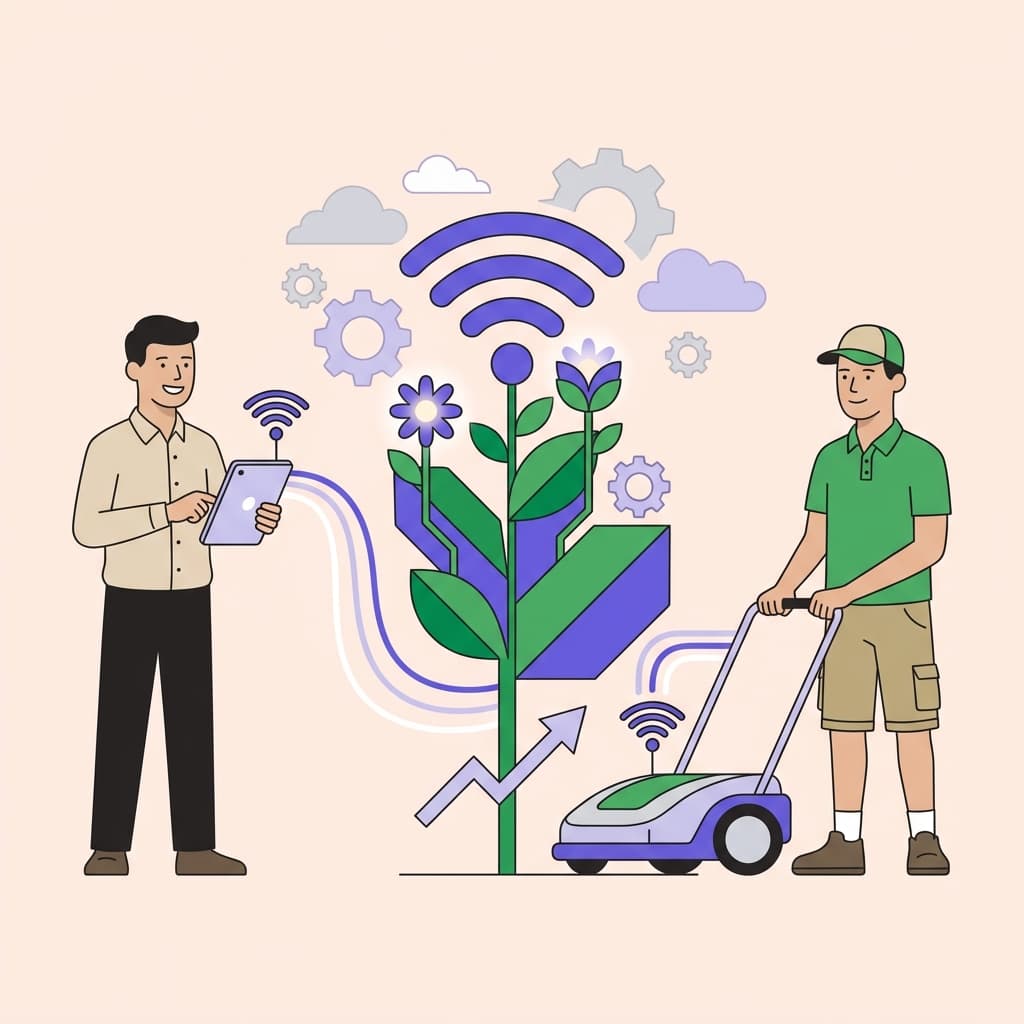
In lawn care, the scary part isn’t losing one mowing customer, it’s losing a whole route and not noticing until your week suddenly opens up. You didn’t get worse at striping, edging, or keeping a consistent schedule. What changed is how homeowners decide who to hire. Instead of scrolling through ten companies, more people ask AI tools, “Who should I use for lawn mowing and fertilization near me?” and then pick from a short list. Lawn care marketing in the age of AI is about being easy to recommend: clear services, consistent proof, and trust signals that match what homeowners care about.
The new “neighbor recommendation” is an AI prompt
Homeowners still ask friends and neighbors. But now that conversation often turns into a quick AI check:
- “Who offers weekly mowing in my area March through November?”
- “What company can fix brown patches and weeds?”
- “Is aeration worth it in the fall?”
- “What’s a fair price for a treatment program?”
AI answers are stitched together from your Google Business Profile, your website, third-party directories, review text, photos, and general mentions of your company online. If your business looks inconsistent (different phone numbers, unclear service area, vague service descriptions), you can get skipped even if you’ve been in town for years.
If you want a big-picture view of what’s changing with AI search behavior and why it matters for local service businesses, read: 2026 AI Search Report: How Americans Are Using AI and What It Means for Your Business.
Is AI Recommending Your Business?
See how you stack up against your competitors and let Pantora get you to the top.
Make your company “machine-readable” (so it becomes recommendable)
Most lawn care professionals already know what good operations look like: consistent routes, predictable service windows, clean equipment, and dependable communication. Your online presence needs the same consistency.
Here are the fundamentals that prevent AI (and homeowners) from hesitating.
Lock down your business identity everywhere
Your name, address (or service-area setup), and phone number should match exactly across:
- Google Business Profile
- Website header/footer and contact page
- Facebook, Yelp, Angi, Nextdoor
- Local chamber or neighborhood directories
AI doesn’t “assume” that two slightly different listings are the same company. It treats mismatches as uncertainty.
Be honest and specific about service areas
Lawn care is hyper-local. You may be willing to drive, but you don’t want to be recommended for neighborhoods you can’t serve consistently.
Instead of “serving the entire metro,” list the towns, suburbs, or zip codes you actually route efficiently. This also helps you attract the customers you want: recurring mowing and annual treatment plans, not one-off out-of-area requests.
Spell out services like a homeowner would say them
A lot of lawn care websites use broad categories like “lawn maintenance.” AI tools (and customers) respond better to explicit, plain-language services:
- Lawn mowing (weekly/biweekly, March–November)
- Fertilization and weed control programs ($200–$600/year range, with factors)
- Core aeration (especially fall)
- Overseeding (often paired with fall aeration)
- Leaf removal and fall cleanups
- Spot treatments for weeds or disease (only if you offer it)
Also clarify what you don’t do. If you don’t offer irrigation repair, tree work, or landscaping installs, say so. Being specific reduces bad leads and increases “fit” leads.
Show proof that you’re a real local operator
In lawn care, stock photos are everywhere. Real photos are a separator.
Post images of:
- Your truck and trailer (with branding visible)
- The same crew on-site (consistency matters)
- Before/after of edging lines, cleanup, overseeding progress
- Seasonal work: spring green-up, summer mowing height, fall leaf removal
Homeowners are trying to avoid two things: a lead broker and a company that can’t keep a schedule.
Reviews that win in AI results look different than “Great job!”
In a lawn care business, you’re often selling a relationship, a recurring service with repeated visits. That means review text needs to signal reliability, not just one good day.
What to ask customers to mention (so reviews actually help you get picked)
After you finish a job (or after the first month of a new recurring customer), send a short text:
“Hey [Name], thanks for having us out. If you can leave a quick review, it helps neighbors find us. If you mention what we do for you (mowing, fertilization/weed control, aeration, leaf cleanup) and your area, it really helps.”
That tiny prompt produces reviews AI can use, such as:
- “Weekly mowing in [Town], always the same crew, always on schedule.”
- “Fertilization and weed control program cleared up dandelions and crabgrass.”
- “Fall aeration and overseeding filled in thin spots by spring.”
- “Leaf removal was fast and the beds were clean afterward.”
Generic reviews (“Great service”) don’t tell AI what you’re great at. Detailed reviews become your best marketing copy because customers write it in the language other homeowners use.
How many reviews is enough?
The bigger lever is recency. A lawn care company with steady, recent reviews usually looks safer than one with 150 reviews that stopped two years ago. Pick a weekly target your team can hit consistently (even 2–5 per week), especially during peak season.
Bad reviews: respond like a professional, not a defendant
In lawn care, complaints usually fall into a few buckets: missed visit, scalping from mowing too low, clippings left behind, weeds “still there,” or billing confusion.
A solid response template:
- Acknowledge the frustration
- Reinforce your standard (schedule, mowing height policy, satisfaction guarantee)
- Offer to fix it and move the conversation offline
Your tone matters. Prospective customers judge how you handle the tough moments, not just the easy ones.
Build pages that answer lawn questions (and pre-sell your program)
AI platforms prefer sources that explain topics clearly. A brochure website that only says “Quality lawn care, free estimates” gives AI almost nothing to cite.
Think in terms of “question-based pages” tied to your money makers.
High-performing page topics for lawn care companies
- Weekly lawn mowing service: what’s included (mow, edge, blow), service window, March–November expectations, and how you handle rain delays
- Fertilization & weed control program: what’s in the program, typical annual range ($200–$600/year), what affects price (lot size, weed pressure, number of applications), and realistic timelines
- Aeration: why fall is best for fixing many lawn problems, what homeowners can expect, and whether you recommend overseeding with it
- Overseeding: who needs it (thin lawn, bare spots, after summer stress), watering expectations, and when results show
- Leaf removal: one-time vs recurring visits, what “cleanup” includes, and how you schedule around peak leaf drop
- Service areas: towns/neighborhoods you actually run routes in (and why that improves consistency)
Include lawn facts that build authority (without sounding like a textbook)
Two simple facts that both help customers and signal expertise:
- Lawns typically need about 1 inch of water per week (rain + irrigation).
- Mowing height affects lawn health; cutting too short can stress grass and increase weeds.
When you explain these in plain language, you sound like a professional, and AI has concrete statements it can reuse.
Add trust signals lawn customers care about
Plumbing customers look for licensing and emergency response. Lawn care customers look for reliability and predictability. Make these visible:
- Licensed applicator (if you apply fertilizer/weed control and your state requires it)
- “Same crew” policy when possible
- Consistent schedule and communication process
- Satisfaction guarantee (and what it means in practice)
- Insurance coverage (briefly, clearly)
A realistic weekly marketing rhythm for lawn care (even in peak season)
You don’t need a full rebrand to win. You need consistency, the same thing you deliver operationally.
Here’s a simple cadence that works during mowing season and still supports fall services.
-
Pick one service to promote for the week
Example: “Fall aeration + overseeding” in September/October, or “weed control program” in spring. -
Post proof from the field (3 photos + 3 sentences)
On your Google Business Profile and/or website blog/news section, post a quick job recap:
- Where (town/neighborhood)
- What you did (aeration + overseeding, mowing, leaf cleanup)
- The outcome or next step (“Water daily for 10–14 days,” “Next treatment in 4–6 weeks”)
- Ask for reviews intentionally
Don’t wait for “happy customers” to remember. Trigger the ask:
- After the first month of mowing
- After a visible improvement (weed reduction, thicker turf)
- After fall cleanup (relief is high)
-
Tighten your listing details monthly
Check for duplicates, wrong phone numbers, outdated hours, and mismatched service areas. National franchises and directories change data constantly; you want your info to stay clean. -
Publish one FAQ you hear all the time
Keep it short (200–500 words). Examples:
- “Should I bag grass clippings or mulch them?”
- “Why does my lawn have brown patches in summer?”
- “When is the best time to aerate in [Your State/Region]?”
If you want more ideas specifically on creating demand from AI-driven discovery (not just rankings), this is a strong follow-up: AI-Driven Lead Generation Strategies for Home Service Businesses.
How to tell if AI is mentioning your lawn care business (and why it changes)
With traditional search, you can track rankings and clicks. With AI answers, visibility is messier: you might be recommended today and missing tomorrow because the model draws from different sources, weighting, and freshness.
What to monitor:
- Are you mentioned for “lawn mowing near me” and “fertilization/weed control near me” prompts in your service area?
- What reasons show up when you’re recommended (reviews, scheduling, specific services, licensing)?
- Which competitors appear instead, national franchises, regional companies, or solo operators, and what do they have more of (recent reviews, clearer service pages, better photos)?
- Is the AI describing your services correctly (or inventing services you don’t offer)?
Tools like Pantora help you track how your business shows up across AI platforms and what to fix to improve your chances of being recommended.
Why lawn care companies get skipped (even when they do great work)
When lawn care professionals say “We should be busier,” it’s usually not because the market disappeared. It’s because their online signals don’t match how homeowners choose.
Your services look too generic
If your site only says “lawn maintenance,” AI can’t confidently match you to “aeration and overseeding” or “weed control program.” Specificity wins.
You don’t look consistent
In lawn care, consistency is the product. If you don’t communicate your schedule (weekly/biweekly, rain policy, same crew), homeowners assume chaos.
Your proof is thin during the seasons that matter
If you only post in spring, you miss fall, and fall is the best time to fix many lawn problems. Keep photos and updates flowing during aeration/overseeding and leaf season.
Your reviews don’t mention the work
“Great job” doesn’t help someone choosing between you and a franchise. Reviews that mention mowing reliability, weed control results, and fall services do.
You’re missing key trust signals
Licensed applicator status, clear guarantees, and visible contact info reduce hesitation. Hesitation is what keeps you off the short list.
Wrap-up: be easy to trust, easy to understand, easy to recommend
AI isn’t replacing referrals, it’s amplifying them. The lawn care professionals who win are the ones with clean business info, steady recent reviews that describe real services, and pages that answer the questions homeowners actually ask (especially about mowing schedules, weed control programs, and fall aeration). Pick two upgrades you can finish this week, keep the cadence, and you’ll make it much more likely that when a homeowner asks AI who to hire, your company shows up with the right reasons attached.