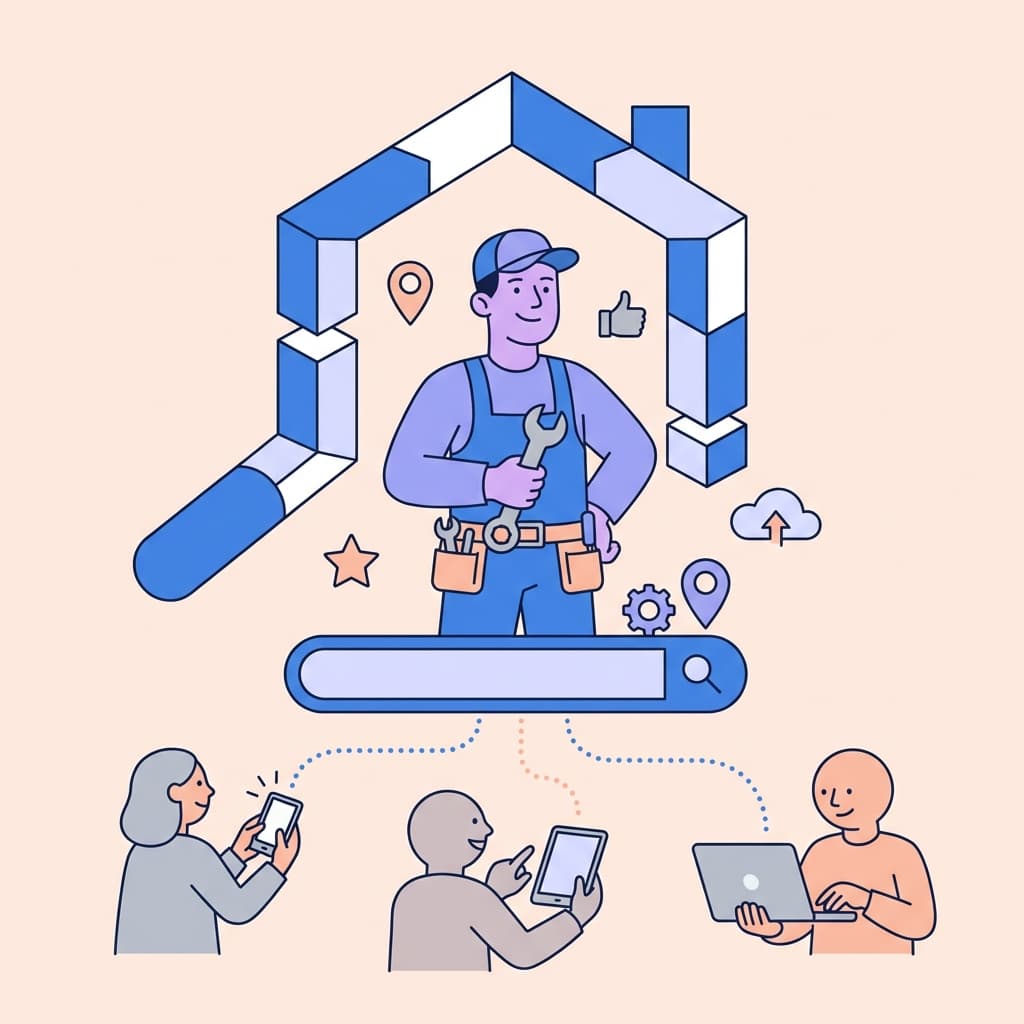
It’s 8:30 PM and a homeowner is standing in the living room staring at a crooked TV mount, a door that won’t latch, and a “honey-do list” that’s now three pages long. They don’t want a general contractor, and it’s not big enough for a specialized trade to bother with. So they open their phone and type “handyman near me” … or they ask an AI tool, “Who can mount a TV and fix a door this week?” If your business shows up in that moment, that’s not luck. That’s SEO and AEO doing their jobs.
The two ways people find a handyman now: search results and AI answers
Most handyman owners think of marketing as “get me more calls.” The channel matters less than the outcome, but the path has changed:
- SEO (Search Engine Optimization) helps you appear when someone searches on Google or Bing.
- AEO (Answer Engine Optimization) helps you get suggested when someone asks ChatGPT, Google AI Overviews, Perplexity, and similar tools for a recommendation.
The handyman industry is especially affected by this shift because you’re competing with:
- a lot of solo operators (often with minimal online presence),
- franchise handyman services with strong marketing systems,
- and task-based apps that can flood a neighborhood with options.
In other words, visibility isn’t just “nice.” It’s the difference between staying booked with $200–$500 jobs and constantly chasing the next small repair.
Is AI Recommending Your Business?
See how you stack up against your competitors and let Pantora get you to the top.
SEO: getting your handyman business to show up when homeowners search
SEO is the set of actions that help your company appear when people search for services like:
- “furniture assembly [city]”
- “TV mounting near me”
- “door repair handyman [neighborhood]”
- “odd jobs handyman [city]”
- “minor plumbing repair [city]”
- “replace bathroom fan handyman”
For handymen, SEO is usually a mix of three things working together:
1) Your Google Business Profile (the “map results”)
When homeowners search locally, Google often shows a map and a short list of businesses first. If you’re not visible there, you’re missing the highest-intent leads, the “I need this done” crowd.
2) Your website (service pages that match real jobs)
Handyman websites fail most often in one way: they’re vague. A single “Handyman Services” page doesn’t match what people search. Homeowners search by task and annoyance: “hang curtains,” “patch drywall,” “install smart lock,” “fix squeaky door.”
3) Trust signals (reviews + consistent info)
Handymen fill the gap between DIY and licensed trades. In many states, there isn’t a handyman license that automatically reassures people. So homeowners lean hard on what they can verify quickly:
- reviews,
- photos,
- clear pricing expectations (hourly or flat),
- and credibility signals like insurance and background checks.
If you want your phone to ring, you have to look like the safest choice.
AEO: becoming the recommendation when someone asks an AI tool
AEO is about getting your business included when someone asks an AI assistant questions like:
- “Who’s a reliable handyman near me for a few small repairs?”
- “What handyman can assemble IKEA furniture and mount a TV?”
- “Is there an insured handyman in [city] with good reviews?”
- “Who can handle minor electrical and plumbing without a huge minimum charge?”
Instead of listing ten websites, AI tries to produce a direct answer or a short set of options. That changes how you win.
Here’s the practical difference for a local handyman:
- SEO = show up in a list.
- AEO = get named as the solution.
And because handyman jobs are often smaller-ticket and fast-deciding, being “the answer” can shortcut the entire shopping process.
Where AI tools pull information about handymen
AI systems gather signals from the same places homeowners already trust, plus whatever your website clearly explains. In practice, the biggest sources tend to include:
- Google Business Profile content (services, service area, photos, reviews)
- Your website pages (especially specific services and FAQs)
- Third-party platforms and directories (Yelp, Nextdoor, Angi, Facebook, etc.)
- Mentions around the web (local blogs, community pages, “best handyman” lists)
- Consistency and activity (recent reviews, fresh photos, updated hours)
If your online footprint is thin, AI will either ignore you, or worse, describe you inaccurately. For example: if you do TV mounting every week but never mention it clearly on your site and profile, you may not show up when the AI is answering “TV mounting handyman near me.”
Why handymen need a slightly different playbook than plumbers (or other trades)
A handyman business has unique marketing challenges that SEO/AEO strategies should reflect:
- You’re task-based, not system-based. People don’t search “handyman services” as often as they search “fix door that won’t close.”
- Many jobs are bundled. Homeowners often want 3–8 small things done in one visit. Your content and reviews should reflect that “knocked out a whole list” value.
- Licensing is inconsistent by state. Since “licensed” isn’t always a clean differentiator, your credibility has to come from clarity, proof of work, and professionalism.
- Competition is messy. You’re up against hobbyists, side-giggers, app-based labor, and high-end remodel companies that take small jobs when they’re slow. Your positioning must be clear.
What to publish so Google and AI understand what you actually do
The fastest way to improve both SEO and AEO is to make your services obvious in language homeowners already use.
Build pages around common handyman “money tasks”
Instead of a generic services list, create dedicated pages (or at least strong sections) for your most-requested and most-profitable work. For many handymen, that includes:
- Furniture assembly (IKEA, Wayfair, beds, dressers)
- TV mounting (including hiding wires, soundbars)
- Door repairs (sticking doors, latches, hinges, weatherstripping)
- Drywall patching and small paint touch-ups
- Minor plumbing (faucet swaps, toilet flappers, leaks under sink)
- Minor electrical (light fixtures, ceiling fans, where allowed)
- Smart home installs (smart locks, doorbells, thermostats)
- Move-in / move-out repairs for landlords and sellers
On each page, include the details that stop hesitation:
- what’s included (and what’s not),
- typical pricing approach (hourly vs flat-rate per task),
- whether you bring materials or the homeowner supplies them,
- how soon you can schedule,
- and the areas you serve.
This is especially important for AEO because AI needs clear statements like: “Offers TV mounting and furniture assembly in [city], insured, background-checked, flat-rate options available.”
Add a “bundle jobs” message that reflects real buying behavior
Homeowners often want multiple small fixes handled efficiently. Spell that out on your site and profile:
- “Perfect for honey-do lists”
- “One visit for multiple small repairs”
- “Minimum charge applies, so bundle tasks to save”
That single positioning detail can increase close rate and helps AI match you to prompts like “I need several small things done.”
Reviews: the shortcut to trust for handyman work
Because many handyman projects are inside the home, homeowners are evaluating you on safety and reliability as much as skill. Reviews are the clearest proxy.
The trick is that generic reviews don’t rank or convert as well. “Great guy” is nice. But it doesn’t help you appear for “door repair” or “TV mounting.”
When you request a review, give customers a simple prompt they can follow:
“If you can, mention what we helped with (TV mount, door repair, furniture assembly, small plumbing fix). Those details help other homeowners find us.”
Also, photos matter more for handyman work than many owners realize. A “before/after” of a repaired door frame, mounted TV, or assembled furniture is instant credibility, both for people browsing and for platforms interpreting your legitimacy.
Clean data beats clever marketing (especially with AI in the mix)
AI and search engines are unforgiving about inconsistent business information. If your hours, phone number, or service area differ across platforms, you create friction and mistrust.
Do a quick audit of:
- business name formatting (same everywhere),
- phone number and website link,
- hours (including holiday changes),
- service areas (don’t claim cities you won’t drive to),
- categories (choose what you want calls for, don’t select everything).
For handymen, also make sure your service list isn’t overly broad in a way that scares people off. “Minor electrical” is fine. “Electrical wiring” may attract the wrong jobs and create liability questions.
A simple routine a busy handyman can actually keep up with
You don’t need a marketing department. You need consistency.
Weekly (60–90 minutes)
- Add photos to Google Business Profile: 3–5 photos from real jobs (TV mounts, door repairs, drywall patches, assembled furniture).
- Request reviews: text 3 recent customers right after you finish and everything works.
- Answer one FAQ on your site: “Do you provide the TV mount?” “Can you mount on brick?” “Do you charge hourly or per project?”
Monthly (half day)
- Improve one key service page: add pricing guidance, add photos, add a short “What to expect” section.
- Update your “Areas Served” wording: keep it honest and consistent across your website and Google profile.
- Create one short “problem” post: examples: “Door won’t latch? Common causes and quick fixes” or “How to choose the right TV height.”
Quarterly (one bigger effort)
- Build a repeatable review system: one template, one tracking sheet, one follow-up message.
- Create a landing page for a seasonal surge:
- Spring: “Spring home prep handyman checklist”
- Holidays: “Holiday honey-do list help”
- Move season: “Move-in/move-out repairs for homeowners and landlords”
If you want to track whether these efforts are actually getting you mentioned inside AI tools (not just Google), Pantora can monitor your visibility across AI platforms and point you to the exact fixes that increase your chances of being recommended.
How to tell whether AI recommendations are impacting your leads already
AEO can be happening even if you’ve never typed “AEO” in your life. Watch for signs like:
- Customers saying “I asked ChatGPT who to call” or “Google’s AI showed your name.”
- Fewer website visits but steady (or rising) calls and texts.
- Leads coming in with very specific framing: “Do you do TV mounting with wire concealment?” or “Are you insured and background checked?”
- A franchise competitor suddenly showing up more, even if you’ve been established longer, often because their services and review volume are clearer online.
If you’re seeing a slowdown and can’t tell what changed, this is a useful companion: How Google AI. It explains why search results are evolving and what that means for local businesses.
If you’re invisible online, fix these handyman-specific gaps first
Most handyman businesses don’t have a “marketing problem.” They have a clarity problem. Start here:
- Your top services aren’t spelled out. If you want TV mounting and door repair calls, those phrases must exist prominently on your site and Google profile.
- You look like you do “everything.” Homeowners want a jack-of-all-trades, but they still need to recognize their exact task in your wording.
- Your reviews don’t mention tasks. You might have 80 reviews, but if none say “assembled furniture” you’ll miss those searches.
- No recent activity. A profile with old photos and last review from 10 months ago gets skipped.
- Pricing is mysterious. For $100–$500 jobs, people want to know whether you’re hourly, have a minimum, or do flat-rate per task.
A strong first move: pick one high-demand service (like TV mounting), make a dedicated page for it, add 10 job photos over the next month, and generate 5 reviews that mention “TV mounting.” That one sequence can lift both Google visibility and AI recommendation odds.
Handyman SEO and AEO are not about trendy tactics. They’re about making it extremely easy for homeowners, and the tools they use, to understand what you do, trust you, and contact you. Get your Google profile tight, publish pages for the tasks people actually search, and build reviews that describe real jobs. That’s how a local handyman stays booked even as search and AI keep changing.