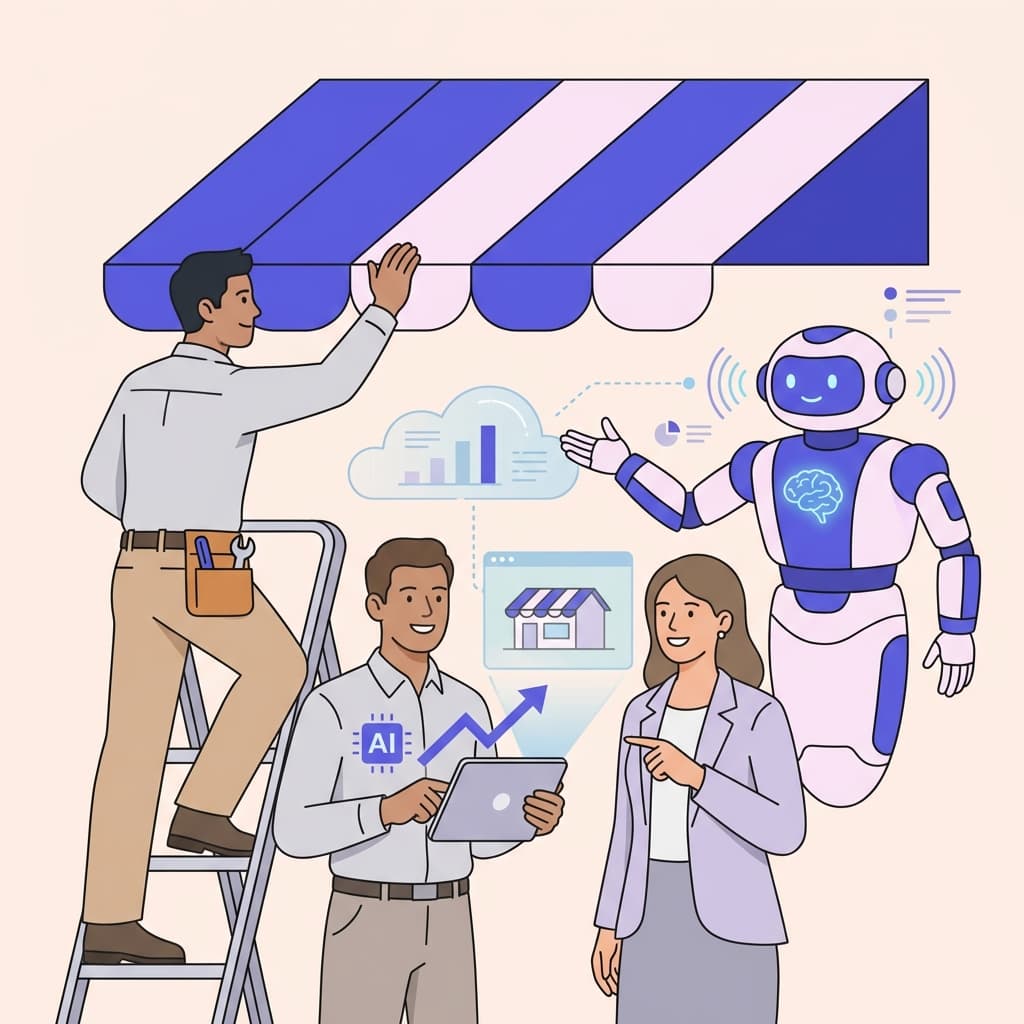
A homeowner is standing on their back patio at 4:30 pm, squinting into the sun, watching their outdoor cushions fade and their kids abandon the table because it’s too hot. They don’t want to “research awnings.” They want someone to tell them what to install, what it costs, and who can do it without the project turning into a mess. Increasingly, that “someone” is an AI assistant. If your awning business isn’t easy for AI (and humans) to understand and trust, you’ll be invisible at the exact moment that homeowner decides to buy.
The new “word of mouth”: how people choose an awning installer now
Awning projects are rarely emergencies, but they are high-intent: once someone decides they need shade, they want a plan quickly. And instead of clicking through ten websites, homeowners are asking questions like:
- “Best retractable awning installer near me”
- “What’s the difference between a canopy and a shade sail for a patio?”
- “Who repairs storm-damaged awnings in [town]?”
- “How much does an awning cost installed?”
Then they pick from a short list.
AI tools (Google’s AI results, ChatGPT-style assistants, Perplexity, etc.) pull from signals across the web: your Google Business Profile, reviews, your website service pages, photos, and third-party listings. If those sources don’t clearly match, services, locations, credentials, warranties, you may still get some traffic, but you’re less likely to be recommended.
If you want a broader view of how Americans are changing search behavior, this report is useful context: 2026 AI Search Report: How Americans Are Using AI and What It Means for Your Business.
Is AI Recommending Your Business?
See how you stack up against your competitors and let Pantora get you to the top.
Before you “market,” make your business legible to machines
In the awning world, competitors come from two directions: specialized awning companies and general contractors who “also do shade structures.” AI doesn’t automatically know which one you are. You have to make it obvious.
Here’s what to tighten up first so you stop losing opportunities to confusion.
1) One identity everywhere (no “close enough” details)
Your business name, phone number, and address/service area should match across:
- Google Business Profile
- Your website header/footer and contact page
- Yelp/Facebook/Angi/BBB (wherever you’re listed)
- Local chamber or neighborhood directories
Small mismatches (old phone number, “Suite B” in one place but not another) create uncertainty. AI systems tend to avoid uncertain recommendations.
2) Spell out exactly what you install and fix
A lot of awning websites assume “awning” covers it. Customers, and AI, need specifics. List your actual services in plain language, including the ones that drive revenue:
- Awning installation (manual or motorized)
- Retractable awning service and maintenance
- Awning repair (fabric tears, arm issues, motor problems)
- Canopy installation (entryways, windows, commercial storefronts)
- Shade sail installation (anchoring, tensioning, hardware)
- Winterization services (especially for retractables)
If you do structural assessment (you should), say so clearly. The phrase “structural assessment included” is a trust accelerator because it signals you won’t bolt into questionable fascia and call it a day.
3) Define your service area like you mean it
AI recommendations often include neighborhood or suburb language. Don’t just say “Serving the metro area.” Create a clear service area list and keep it consistent across your site and listings.
Also: be honest about travel. If you’ll install but not service retractables outside a 30-mile radius, state that. It prevents bad leads and negative reviews.
4) Use job photos that prove you’re real (and skilled)
This category is visual. Stock photos can actively hurt you because they make you look like a lead broker.
Aim for photos that show:
- The awning fully extended and retracted
- Mounting points and hardware (tastefully, don’t overwhelm the gallery)
- Fabric pattern/color close-ups in natural light
- Before/after shots of torn fabric replacement
- Your crew on-site (clean uniforms and safe ladder setup matter)
Bonus points for labeling photos with location and service: “Motorized retractable awning install, West-facing patio in Gilbert” or “Storm-damage arm replacement, storefront canopy in Naperville.”
Reviews that help you win $1,500–$5,000 projects (not just “more reviews”)
For awning installers, reviews do more than build confidence, they explain fit. Homeowners worry about durability, mounting safety, and whether the final look will match the house. AI tools read reviews for those details too.
What to prompt customers to mention
Instead of begging for “a review,” give gentle direction so reviews contain the information that closes the next sale. Send a text right after the job (or after the first sunny weekend when they’re loving it):
“Hey [Name], glad we got your new shade setup installed. If you have a minute, could you leave a quick review? It really helps. If you mention what we installed (retractable awning / shade sail / canopy) and your neighborhood, it helps neighbors find us.”
That small prompt often produces the exact phrases you want showing up online:
- “west-facing patio”
- “motorized retractable awning”
- “free design consultation”
- “explained fabric options and UV protection”
- “clean install and warranty on installation”
How to respond when someone complains (without torpedoing trust)
Most negative awning reviews are about expectations: wind use, rain runoff, fabric care, or an issue that needs an adjustment. Keep responses short and calm:
- Acknowledge the issue
- State you want to fix it
- Move it offline with a direct contact path
Avoid arguing about weather or “user error” in public. You can educate privately. Publicly, your tone is part of your marketing.
A note about trust signals unique to awnings
In your replies and on your site, mention trust markers people actually care about in this category:
- Manufacturer certified (if true, name the manufacturer)
- Structural assessment included
- Warranty on installation (spell out basic terms)
- Free design consultation (and what it includes: fabric selection, projection, placement)
Website pages that answer real shade questions (and feed AI the right details)
A surprising number of awning websites function like a photo album with a phone number. That can work when referrals are strong, but AI-driven discovery rewards clarity.
Think in terms of “questions customers ask before they buy,” and build pages that answer those questions directly.
Pages worth building for awning companies
- Retractable Awnings (manual vs motorized, wind sensors, typical lifespan, care)
- Awning Repair (fabric replacement, frame/arm repairs, motor troubleshooting, inspection process)
- Canopies for Storefronts & Entryways (commercial value, branding, permitting notes if relevant in your area)
- Shade Sails (engineering/tensioning, attachment points, why cheap installs fail)
- Winterization & Seasonal Maintenance (what you do, when to schedule, what it prevents)
- Service Areas (cities/neighborhoods you actually serve)
- Portfolio (organized by project type: patio retractables, window awnings, commercial canopies)
Add “pricing clarity” without boxing yourself in
Homeowners want a budget check before they talk to anyone. You can provide ranges while explaining what drives cost. For typical jobs in the $1,500–$5,000 range, outline factors like:
- Width and projection
- Manual vs motorized operation
- Fabric grade and UV rating
- Mounting surface and reinforcement needs
- Electrical run for motors (if required)
- Removal/disposal of old units
- Custom frames or commercial signage elements
You can also include a couple of industry facts in a helpful, non-salesy way:
- Awnings can reduce cooling costs by up to 25% by cutting solar heat gain.
- UV-blocking fabrics can prevent about 95% of harmful rays, huge for furniture fade.
- With normal care, retractable awnings often last 10–15 years, so maintenance pages matter.
Make “local and legitimate” impossible to miss
On key pages, include:
- Your certifications and the brands you’re authorized to install/service
- Proof of insurance (and license info if applicable locally)
- Your workmanship warranty language
- A clear process section (consultation → measurement → structural assessment → install → walkthrough)
Awnings are attached to people’s homes and businesses. If you look casual about structure and warranty, you’ll lose to the company that feels more deliberate, even if your installs are better.
A simple weekly marketing rhythm that fits seasonality
Awnings have predictable busy periods: spring installs before summer, storm-damage repairs in fall, and winterization services when temperatures drop. Your marketing should ride those waves instead of fighting them.
Here’s a realistic weekly cadence that builds visibility in both search and AI recommendations:
-
Pick one seasonal theme.
Spring: “patio shade before heat hits.”
Fall: “storm-damage inspections and repairs.”
Winter: “retractable awning winterization and fabric protection.” -
Post one recent job with specifics (photos + 4–6 sentences).
Example: “Installed a 16' motorized retractable awning on a west-facing patio. Completed structural assessment, reinforced mounting points, and added wind sensor. Customer chose solution-dyed acrylic for UV protection.” -
Ask for 3–5 reviews from finished projects.
Make it part of closeout: invoice → warranty info → review link. -
Update one service page with a new FAQ you heard this week.
Good awning FAQs include:- “Can a retractable awning stay out in light rain?”
- “Do I need a permit for a storefront canopy?”
- “Can you mount to brick/stone/stucco safely?”
- “What wind speed should I retract at?”
-
Check your top listings for consistency.
Especially before spring rush, when customers are comparing quickly and AI is pulling details at speed.
If you want more ideas tailored to home service lead flow beyond rankings, this article is a strong complement: AI-Driven Lead Generation Strategies for Home Service Businesses.
Knowing if AI is recommending you (and what it says about you)
This part frustrates owners because it’s not as straightforward as “rank #1 for retractable awnings.” AI responses vary by platform, phrasing, and even user history.
What you want to monitor:
- Are you mentioned for “awning installer near me” prompts in your service area?
- Are you recommended for the right specialties (retractables, repairs, shade sails), or only generically?
- What reasons are attached to your name (reviews, photos, certifications, warranty)?
- Which competitors get suggested instead, and what signals they have that you don’t?
Tools can help you see patterns and prioritize fixes. Pantora tracks how your business appears across major AI platforms and highlights what to change to increase your odds of being recommended.
Why you’re not showing up (even if you do great work)
When an awning business is “busy sometimes” but not consistently getting inbound requests, it’s often one of these:
- Your services are described too broadly. “Awnings” isn’t enough, people want retractable, motorized, repair, shade sails, and commercial canopies spelled out.
- Your proof is thin. Not enough real photos, not enough recent reviews, not enough project detail.
- You don’t look structurally serious online. If your site never mentions assessment, mounting safety, or warranty, you’ll lose to the company that does.
- Your online info is inconsistent. Duplicate listings, old phone numbers, or mismatched service areas create uncertainty that AI avoids.
- Your competitors publish clearer “answer” content. A general contractor with a surprisingly good “retractable awning cost” page may get recommended over a specialist with a vague brochure site.
Closing thought: AI rewards clarity, not hype
You don’t need clever branding to win awning projects in the age of AI. You need a presence that’s easy to verify: consistent listings, specific service pages, real job photos, steady reviews, and trust signals (certifications, structural assessment, warranty, consultation). Do two improvements this week, keep the cadence, and you’ll start seeing the compounding effect, especially heading into the spring installation rush.